I was talking with a young founder whose software helps agencies deploy and manage AI voice agents for their clients. He talked about how so many of the “AI-native” agencies that became his customers last year flamed out quickly. They might have ramped up revenue with aggressive outbound campaigns and sales efforts, but they ultimately couldn’t retain their clients and had to shut down. Many were fresh-out-of-college types looking to ride the AI wave and attracted to the zero-capital startup costs of launching an agency.
This didn’t sound too different than some of the DTC and Amazon agencies that popped up during COVID, with young founders sharing their “6-figure MRR” screenshots on social media while also starting to sell courses on how to build agencies.
I’m actually relieved that Sei-Wook and I came up in an era where such bravado and chest-thumping didn’t exist. Twenty years ago, we started off very slow. The first five years were a slog, barely scraping by but foundational years for building long term relationships with employees and clients.
Today, with the higher cost of living and more intense competition, I’m not sure our tortoise approach would work, but then again, it’s pretty much exactly what we’re doing with our holdco, moving very slow and focusing on what we care about: relationships and the portfolio companies we already own. We’re also being deliberate about acquisitions and taking a careful stance with raising outside capital. I sometimes look around and see hares zipping by, stacking acquisitions and deploying institutional capital. Not too different from when we ran 1 agency and saw other agencies scale faster, land bigger clients, and move into bigger offices.
But this is where experience and perspective has come in handy. We can observe and learn from those who are experiencing rapid success, but we have no way to know the complete picture. They may have different goals than us, different priorities, and different time tables. They might have different pressures and stakeholders that we’re unaware of. And while some may achieve incredible outcomes, others will stumble along the way or cease to exist.
All this is to say: we’ll focus on running our own race, keep our eyes on the goals we’ve set for ourselves, and go at the pace that makes sense for us.
About Agency Journey: This is a monthly series detailing the happenings at Barrel Holdings, a portfolio of agency businesses. You can find previous episodes here.
Highlights
AgencyHabits x Automattic Webinar
Automattic, the folks behind WordPress VIP and WooCommerce as well as other commercial aspects of WordPress, have been sponsors of AgencyHabits this quarter. We collaborated on a webinar in May to talk about AI search and the impact on agencies.
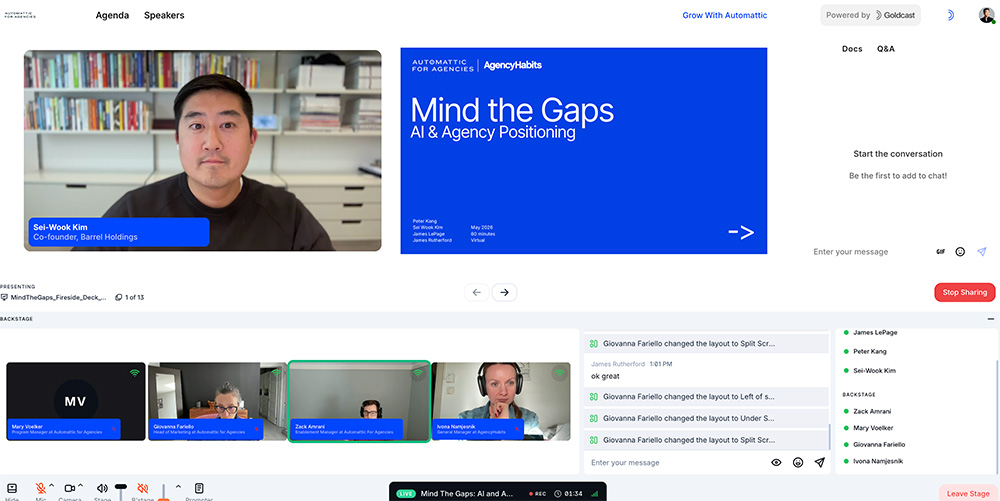
Sei-Wook and I participated in a webinar with the folks at Automattic around AI search and agency positioning.
Sei-Wook and I weighed in on the importance of positioning and specialization in the age of AI search. We touched upon our Foundation concept and shared some examples from our Barrel Holdings portfolio. Over 200 agency leaders signed up and 80+ people attended the webinar live. We’ll see if Automattic continues the partnership with us, but the experience left me with greater conviction that our Foundation concept – the positioning, ICP, service offering, and ecosystem definition process – is something that we ought to continue sharing and teaching. Done well, it’s one of the highest ROI activities that an agency can undertake.
Euro Trip: AgencyHabits Meetup in London and flowConf in Belgrade
I spent nearly a week in Europe in May. The first part of my trip was in London, where we held an AgencyHabits Meetup for folks who subscribe to our content. It was great catching up with some agency owners I’ve known a long time and also cool to meet with folks I’ve connected with via LinkedIn. The turnout of 20+ was more than I had expected.
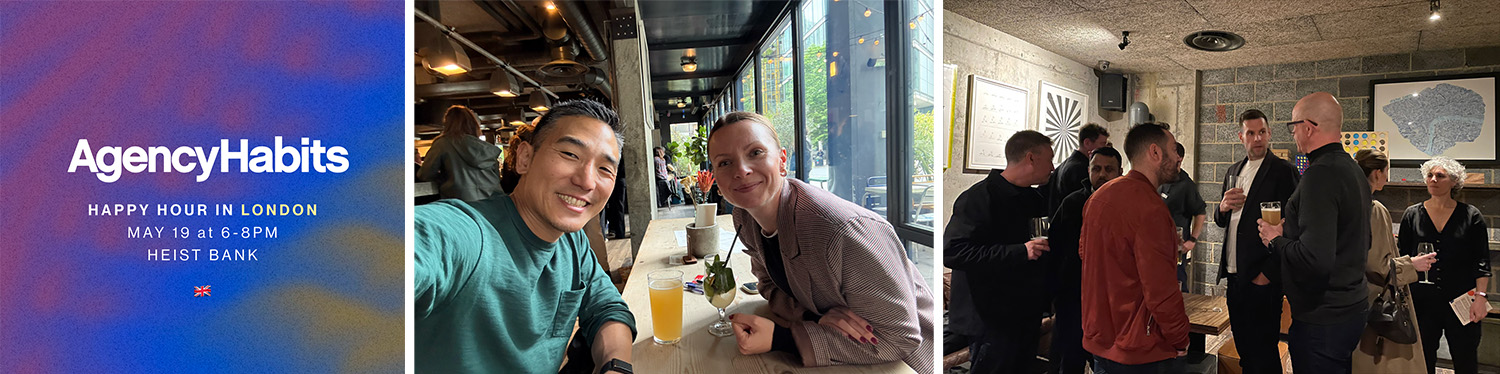
Our AgencyHabits meetup in London was a success, a good turnout of agency folks. I finally got to meet in person with Ivona, GM of AgencyHabits who flew in from Croatia.
It was also the first time I got to meet in-person with Ivona, our General Manager of AgencyHabits. She flew in from Croatia to help put on the event. I also met with a few other agency folks while I was out there including a wonderful lunch with Felix Velarde, author of Scale at Speed: How to Triple the Size of Your Business and Build a Superstar Team, an excellent resource for agencies looking to grow.
I then made my way to Serbia, where flowConf, put on by my friend and Webflow agency owner Uros Mikic, took place in Belgrade. I was invited to present on a topic for agency owners: Scaling Business Development Beyond the Agency Founder.
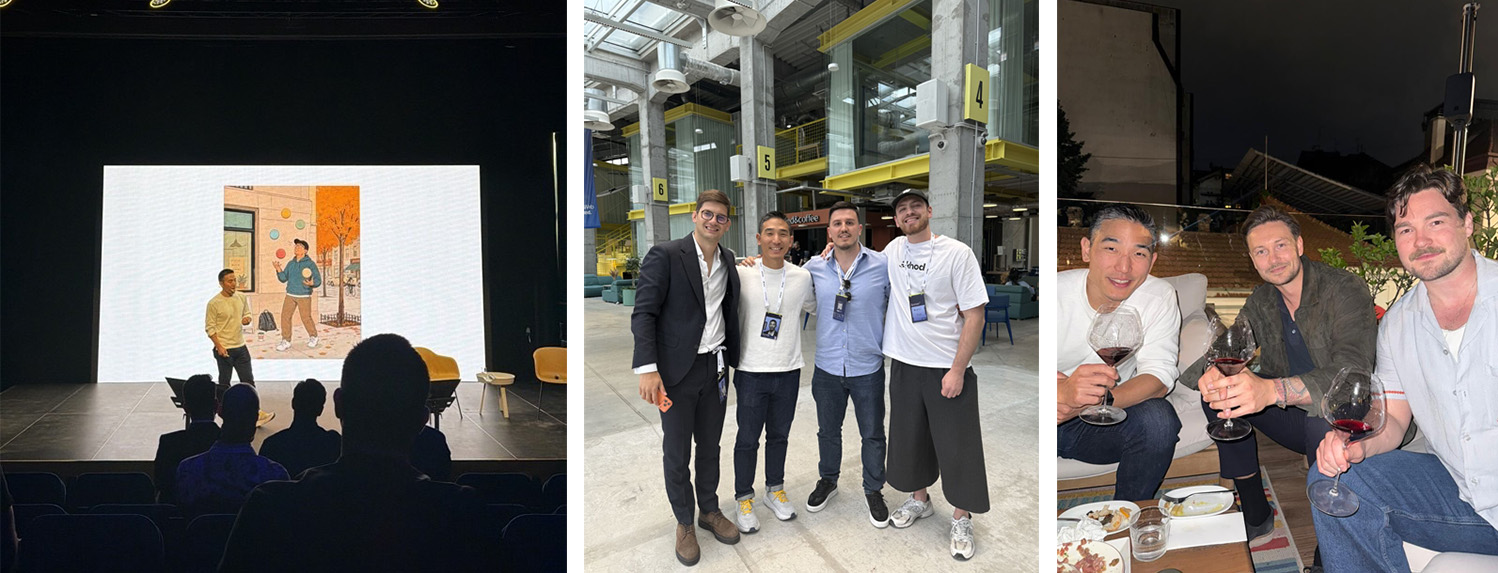
I gave my talk on scaling biz dev beyond the agency founder at flowConf 2026 in Belgrade, Serbia. I got to meet a lot of great agency founders from all over Europe, including a couple guys from Norway (right) with an appreciation for wine (Martyn & William of Ish Studio).
The talk came together last minute, and I felt good giving it. I got to meet a bunch of agency founders from across Europe who were fans of AgencyHabits and eager to chat about how they could grow their businesses. That was neat, and a validation that many of the topics we discuss on our podcast and on my LinkedIn posts are helping people in various ways.
I enjoyed the short time in Serbia and was impressed by the concentration of talent there. It’s no wonder that many US agencies have engineering or delivery outposts based in Serbia. Our AO2 team, I learned, has team members based there as well.
Top of Mind
The Math Problem with Smaller Tuck-Ins
In May we had a few conversations with agencies that could potentially be absorbed by one of our larger Barrel Holdings agencies (e.g. Barrel, AO2, BX). The appeal of these agencies is usually one or more of the following:
- Key accounts and client relationships (their book of business)
- Their capabilities (serving the same ICP)
- Their personnel (fills a specific role/need)
On rare occasions, these agencies might also be enticing for their brand and reputation, having solid inbound numbers. But in most cases, these agencies are looking to sell because business development is tough and growth is elusive. In some cases the founder is looking to transition their employees and clients to a new home with plans to do something different after the transaction, and in other cases, the founder is looking for a more secure paycheck vs. the volatility of owner distributions.
But here’s where these types of deals have typically fallen apart for us and why I don’t see us doing many of these: most agency owners want some kind of multiple on SDE (seller’s discretionary earnings), which is usually their salary plus whatever distributions they’ve taken from the business. The problem is that their revenue quality is usually uneven, ranging from one-time project-based to recurring with high churn. It’s hard to pay upfront cash when the revenue history has been up and down.
The seller might have a number in mind, anywhere from 3-5x SDE. Let’s say they’re doing $500k revenue and taking out $150k for themselves. That’s $450k to $750k, let’s pick $600k as their 4x SDE valuation. As buyers, we realize that we need to keep the seller and pay them a salary. They might be okay with $120k, so that means the $150k SDE, with a $120k salary, looks more like a $30k EBITDA business, maybe even less if you account for benefits. So all of a sudden, we’re talking about valuing a business doing $30k EBITDA at $600k, a pretty big spread and one that our model has a tough time underwriting for.
This is where deal terms come into play. We might be comfortable agreeing to the $600k number as the “headline” valuation, but we might pay $60k (10%) of it at close. Then we might stipulate that 20% of all client revenue retained can go towards paying the $540k ($600k minus the $60k cash at close). So if the business does $500k again from the same clients, $100k will pay out in year 1. We could sweeten things further with a bonus payment of $50k if they match or exceed the previous year’s revenue, so then it’d be $390k left ($540k minus $100k minus $50k). We could also layer on 20% rev share for any new logo clients that come through the acquired agency’s relationships. So if they attracted $200k of new biz, that’d be another $40k. Within 3-4 years, if all goes well, the seller could reap the $600k all while making a guaranteed $120k on top.
Some buyers might also offer equity in the acquiring agency with a promise of a “second bite”. Or a chance to participate in some kind of profit share plan. There are endless ways to structure these deals so that there’s some downside protection.
Most of these deals never get this far. Sellers want more cash upfront, they want the earn-out paid out sooner, and they’re usually convinced they can make more money just holding onto the business. When we stay disciplined on margin of safety and a reasonable payback on cash invested, we end up too far apart almost every time. The lesson I keep coming back to: smaller deals don’t get simpler, they get more structural. The smaller the EBITDA, the more the work shifts from negotiating price to engineering the deal (e.g. earn-outs, rev shares, equity rollovers, bonus tiers, second-bite mechanics). You can write almost any number on the LOI if the structure underneath is creative enough to protect both sides.
But structure alone won’t close a tuck-in. The seller has to feel the pull of being part of what we’re building, like being excited about the CEO they’d be working with, the team, the direction we’re heading, etc. and confident that staying involved will make them more money than walking away with a smaller check. Without that pull, every concession on cash becomes a fight, because the back-end of the deal is a bet on the acquiring agency, not a contract.
The math is downstream of the relationship, which is why I have no doubt we’ll do one of these eventually: it’ll happen when a seller wants the deal to be done more than they want the headline number (e.g. a personal transition, burnout, a market they can’t navigate alone, etc.) and is genuinely excited about joining one of our agencies, not just exiting their own. Until then, we expect a lot of rejections, and we’re fine with that.
Shared Quotes
“Money does live on the other side of fear. But in a bigger sense opportunity lives on the other side of fear as well. Money just represents one tangible form of opportunity. It gives you options and allows you to choose.” (Gary Keller, Dave Jenks, Jay Papasan, The Millionaire Real Estate Investor)
As Sei-Wook and I celebrate 20 years of being in business together, there was indeed opportunity on the other side of fear. I’m glad we took the jump.
“When we are unhappy, we are faced with a great choice: Do we recognize that life is inherently complex and filled with obstacles to happiness? Or do we blame others for our unhappiness? Of course, in some truly terrible instances—losing a loved one to a drunken driver, for example—it is quite valid to blame others for one’s unhappiness. But when most unhappy people blame others, they do so because that is easier than to acknowledge life’s complexity or to search within for the sources of their unhappiness.” (Dennis Prager, Happiness Is a Serious Problem)
This is one of the perspectives I’ve gained over the past 20 years in business: things got so much better and I became much happier once I learned to stop blaming clients, employees, and external factors. This realization was probably the reason I was able to keep myself from burning out.