An employee at one of our agencies suddenly passed away in April. She was an important team member, a “glue” person whom everyone appreciated and respected. Her passing was a huge shock for the team.
It was yet another reminder that our time here is finite, that unexpected things can happen, and that life and work go on with or without us.
Sei-Wook and I are coming up on 20 years since we started our first agency together, and while we feel like we are just hitting our prime and have much to do together, it’s also not totally our call on how long we get to do this. Life is short and precious. We have to make the most of each day and be grateful for the opportunity.
About Agency Journey: This is a monthly series detailing the happenings at Barrel Holdings, a portfolio of agency businesses. You can find previous episodes here.
Highlights
Matyx Acquisition Complete, Barrel Holdings Portfolio Now at 6 Agencies
Back in September 2025, I received a LinkedIn message from someone who had seen my post announcing that Barrel Holdings was acquiring specialized agencies doing $500k to $1.5 million in EBITDA. I had put some paid dollars to boost this post. The message was from an exited IT business founder who was now a finder for private equity firms – he would source deals on his own and make intros, netting a finder fee if a deal closed. He usually targeted much larger deals, but every now and then he came across businesses that were too small for the PE firms. When he saw my LinkedIn post, he happened to have an opportunity that was the perfect fit.
Through our finder’s intro, Sei-Wook and I jumped on an intro call with Matyx founder Tucker Pool. He was based in Oklahoma, a hour-plus outside of Oklahoma City. The prior year, he had acquired Lamplight Digital Media, a marketing agency focused on water treatment. He bought it off Merge, a broker for agency businesses. Tucker had his hand in a few different business lines – some IT, some digital marketing, and M&A consulting. He hoped to beef up capabilities and bring on a capable team for his burgeoning digital marketing line through the acquisition.
Things worked out a bit differently. Tucker quickly realized post-close that he needed to rebuild the entire team and do everything in his power to retain the existing clients. What followed was an intense and challenging year of rebuilding the entire business he had just acquired, basically replacing the entire team he bought, and redoing the entire operations.
It was just as things were starting to hit their stride that our finder made contact with Tucker. Tucker wasn’t thinking about selling just yet but he welcomed the conversation and got connected with us.
We hit it off pretty quickly. Sei-Wook and I appreciated Tucker’s incredible “lay it all on the table” transparency. We could tell right away that the business was run efficiently and growing. Tucker was also very responsive and organized. From the first data room request to all the due diligence that would follow, Tucker responded quickly and did whatever he could to clarify any questions we had.
Our finder gave us a couple weeks of exclusivity to negotiate an LOI. We moved quickly and present Tucker with an offer. After a bit of back and forth, we came to an agreement. We had what we felt was a really appealing deal structure. Mostly cash at close, but a very favorable multiple based on trailing twelve month EBITDA. The risk here was that the financial history was fairly recent – Tucker was only a year into having integrated Lamplight. We felt that there was enough margin of safety in the valuation to warrant this bet.
Because it was the end of the year, we agreed to take it slow through the holidays. This gave us time to explore something we hadn’t done at Barrel Holdings: raise money from outside investors. I mentioned in an earlier episode that I can foresee a future where we may need to raise equity for larger deals. While we could’ve funded this deal completely on our own, it felt like a good opportunity to build a track record. We put together our first CIM (confidential information memorandum) and sent it out to potential investors. We eventually got 5 investors to fill our round and learned a great deal in the process. I think by the end of this year, with a few quality cash distributions under our belts, we’ll be in good position to raise a larger amount for future deals.
A key consideration on this deal was the existence of a viable leader to take over for Tucker post-close. Tucker had identified Justyn, the President, as someone who commanded the respect of the team and had the skills to be the leader. We felt that if Tucker overstated this, we’d walk, because we knew how important it was for there to be someone strong and trusted to take the place of a charismatic founder after the acquisition.
Justyn proved to be a stand up leader. He was a no-nonsense type operator who took pride in driving performance across the team. He cared greatly about upholding high standards and not too long after coming onto the team, took over much of Tucker’s hiring responsibilities, being the one to construct the team from the ground up. We felt pretty good about Justyn’s abilities, and decided to keep moving.
In December, Sei-Wook and I went out to Oklahoma City to meet with Tucker in person. We also met his wife D’Lisa who also worked in the business. We enjoyed hanging out with them and had a ball. When we had dinner at a steakhouse, I had assumed that we would pay for dinner, so I ordered a couple wines that were on the high end. But when we went to pay the bill, we were told that Tucker had already put down his card before the meal. I felt bad and called him sneaky, but it was also a reflection of the type of person Tucker is– super generous and thoughtful.
From December through February, it was all about getting the financials in order to shop our deal to potential SBA-backed lenders. We worked with an SBA lending broker and hired an QoE firm to move the process forward. The main complication was that this was essentially a “carve-out” deal, where we were buying just the digital marketing piece of Tucker’s multi-line business. The QoE results showed that the business was slightly more profitable that we had thought, which was a pleasant surprise. After getting a handful of offers from different banks, we went with one that satisfied our terms – no guarantee needed from the holdco and a comfort level with the carve-out.
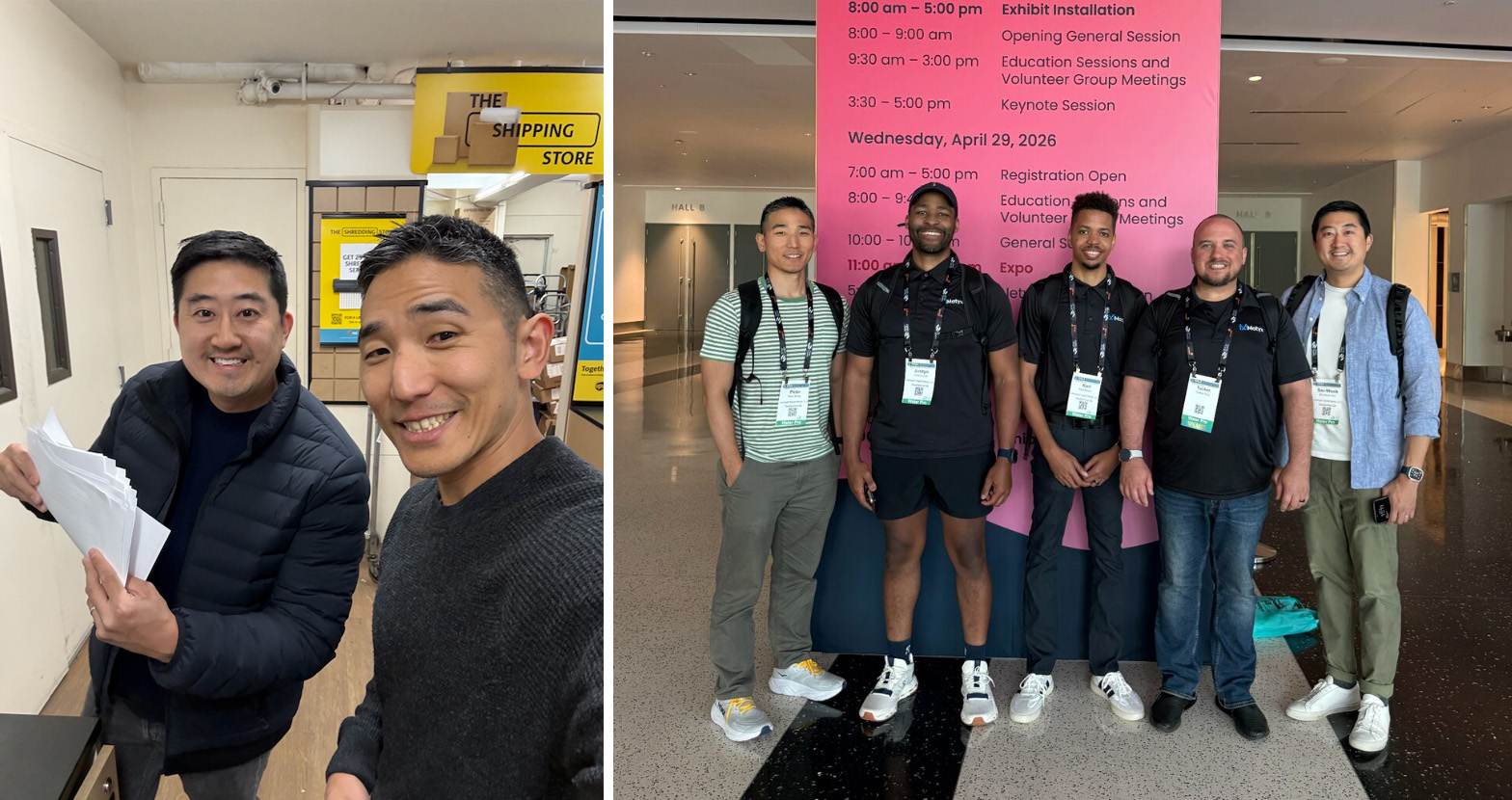
Left, Sei-Wook and I finalized the acquisition by getting contracts notarized and scanned at a UPS in New York City. Right, we hung out with the Matyx team at the Water Quality Association Convention & Expo in Miami Beach.
So, with all that, we finally closed in early April. The overall process, thanks to Tucker’s helpful collaboration, was relatively smooth. Sei-Wook, as he’s done in past deals, brought his full project management prowess to bear–daily check-ins with everyone involved, clear timelines, and methodical execution of every step along the way. It was also great having Brandon, our Head of M&A, supporting us on various aspects of the deal as well.
In late April, Sei-Wook and I traveled to Miami Beach to meet up with Tucker, D’Lisa, Justyn, and Head of Automation at Matyx, Karl. They were there for the Water Quality Association Convention & Expo, where Tucker had been invited to speak on a panel about leveraging AI in marketing water treatment companies. It was fascinating to see hundreds of water treatment business owners all under the same roof, many of them clearly needing the services that Matyx offered.
The first few weeks post-close has been about integration, getting Matyx onto our way of managing finances, getting a PEO in place for payroll and benefits, and developing priorities with Justyn. We think this is a business that has the foundation to scale into a profitable eight-figure agency. The key will be executing on the fundamentals: deliver for clients, retain and recruit quality talent, and continue to innovate on and improve the agency’s processes.
On the M&A front, some key takeaways that confirmed some things for us:
- Deal flow is everything. We will continue to invest in all aspects of generating deal flow – marketing (my LinkedIn content, paid ads, AgencyHabits, speaking engagements), partnerships (brokers, bankers, finders, scouts, and other referral relationships), and buy-side advisors who help us with outbound. Matyx was only possible because of our marketing efforts. We don’t know where our next big deal is going to come from, but it’s important to never let up our efforts.
- Continue to improve deal team quality. We expanded the number of third parties we worked with on this deal vs. the last one. We needed some specialized help and we also had some more accounting, legal, and financing needs this time around. What struck us was that most of the stress during this deal was caused by sloppiness and slow responses from our service providers. They’re supposed to be helping us, but in several cases, they ended up making more work or had to be guided by us in very prescriptive ways. We’ll continue to network with other service providers and replace the ones that disappointed us. We want to get to a place where our deal team is one that we fully trust and feel great about.
- Who the seller is makes a big difference. I’m afraid we’ve been spoiled after working with Tucker. He was the right mix of motivated seller, not in a rush, all about the win-win, and both fast and organized in his responses. It helped that he knew his own business inside out, didn’t need to rely on an intermediary, and was transparent about everything throughout the process. This deal could’ve easily gone off the rails or been delayed further, but having a seller like Tucker definitely smoothed things out.
Some Travel: Agency Hackers and DAB M&A Bootcamp
I attended the Miami Super Summit hosted by Agency Hackers, a group out of the UK that puts on various events for agency owners. I was invited to speak about my experience transitioning from an agency operator to a holdco founder.
I enjoyed my time there, hanging out with some familiar faces and also meeting new ones. I caught up with BX Studio’s COO Sam Zimmerman about their progress and AI’s impact on the business model. I also got to spend time with Mark Homer, a fellow holdco owner who acquired a B2B marketing agency last year and was in the process of looking to roll up more. We talked about holdco governance, capital allocation, and M&A and what we were each building towards. I also enjoyed meeting James Rose, founder of Inflectiv Group, who was making minority investments into agencies in the UK with an eye towards an exit of the portfolio in a few years. The minority investments were an interesting perspective, especially as it’s something that’s crossed our minds in recent months.
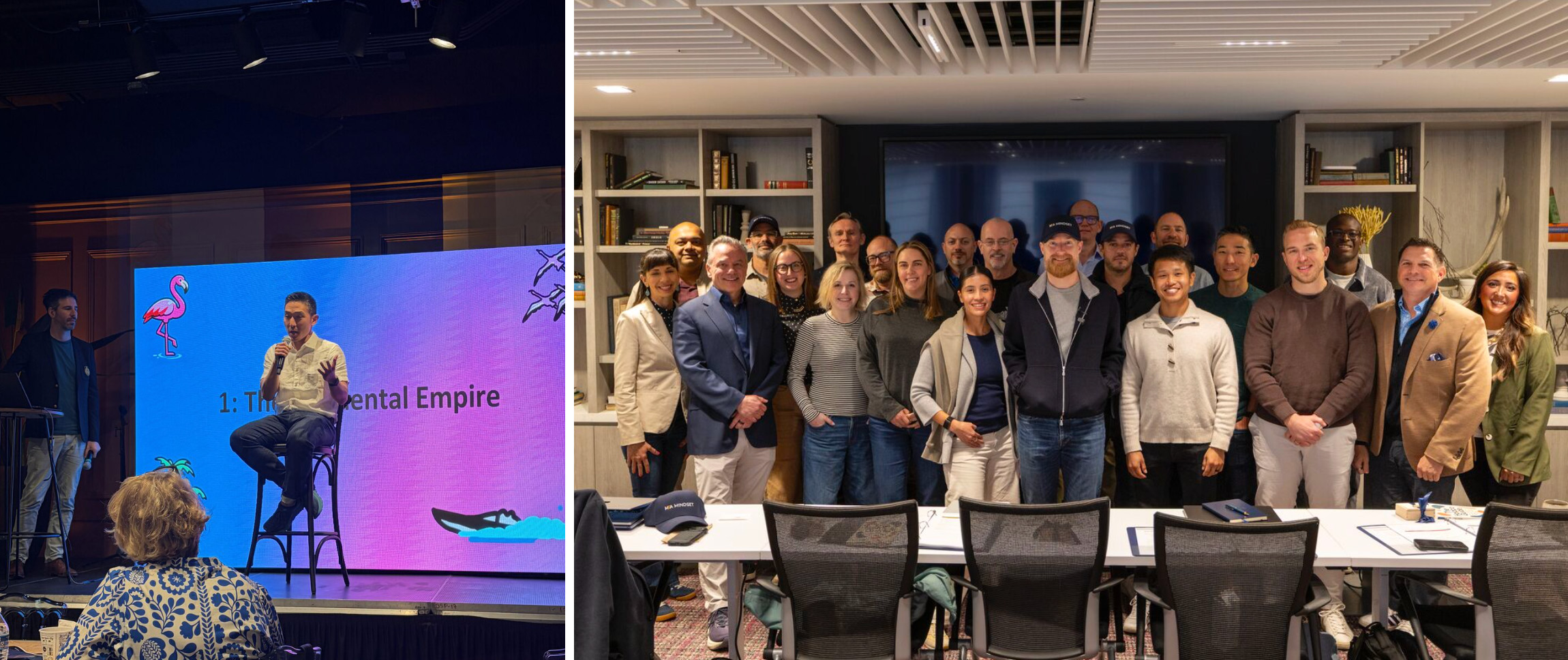
Left, on stage at Agency Hackers event in Miami sharing my story about how Barrel Holdings came to be. Right, attending the DAB M&A Bootcamp in Boston.
The following week, after coming back to Miami for the WQA event with Matyx, I flew up to Boston to attend Peter Lang’s M&A Bootcamp. I met Peter several years ago when we were very early into our M&A journey at Barrel Holdings. I took his course and he’s been a valuable resource for helping me think about deal structures and holdco design. I’ve also met some fantastic people through his M&A community on Slack, including Mark Homer and Grant Hensel, who invested in our Matyx deal as an investor.
I decided to go to the bootcamp in part because I was curious about how the content had changed. Peter’s been working on a book and overhauled his course material in the process. The bootcamp featured the new structure and materials. I was impressed with the neat organization and the clear content. Mark was also in attendance, and the two of us, having had more deals under our belts than most of the attendees, were called upon to share our experiences. Mark and I joked that we felt like TAs supporting Professor Lang.
While most of the content was familiar and fairly basic to me, I still came with some valuable takeaways. One was the importance of the narrative and framing the “state of M&A” for prospective sellers to manage expectations. The other was the idea of a “risk register”, properly documenting an agency’s top risks and having clear actions to mitigate them. I felt this could be handy for our own agencies.
Most importantly, I came away from the bootcamp newly energized to pursue deals more vigorously. I reflected on our M&A activity for the past several months, and it’s been a bit too staid – if the prospective seller’s ask was too high or didn’t fit neatly into our plain vanilla deal structure, we’d automatically pass. Moving forward, we’ll continue to be disciplined about underwriting for risk, but we will be more creative in exploring structures and confidently presenting what we believe are fair offers, even if they don’t meet the seller’s ask. We’ll also explore more creative structures for tuck-ins and acquihires that can benefit our existing agencies.
Barrel Hires a New COO
Our Shopify CPG commerce agency Barrel welcomed Sara Asic as Chief Operating Officer in April. She was most recently the COO at Domaine, one of the leading global Shopify agencies.
The timing couldn’t have been more perfect for Sara to join the team. Lucas had done a great job over the past 2 years of fully taking over Barrel’s operations from me and Sei-Wook, leaning further into the CPG food & bev positioning, and strengthening our base of clients. With an eye towards scaling and expansion, it was clear that Lucas needed someone to oversee delivery and free him up to more fully build up the business development function at Barrel.
Sara brings a wealth of experience in scaling up client services and putting in place delivery processes and personnel. Lucas remarked to me several times in the first few weeks how refreshing it was to have a thought partner and experienced leader really own the delivery side of the business.
Across the holdco, one thing that’s proved out over and over again is that the right hire for the right role can really turbocharge growth and progress within the agency. Placing the right talent still remains one of the highest leverage activities that our agency leaders can partake in, something we can never forget.
Top of Mind
Constructing the Holdco Portfolio Dashboard
Ahead of our Q2 board meeting, Sei-Wook worked to launch our much-awaited holdco portfolio dashboard.
The initial use case was to replace the manual reporting deck that we required from each of our agency CEOs. Instead of stressing to fill out their respective decks the night before the board meeting, our dashboard freed up the CEOs to focus on recapping highlights and articulating their strategic initiatives for the new quarter.
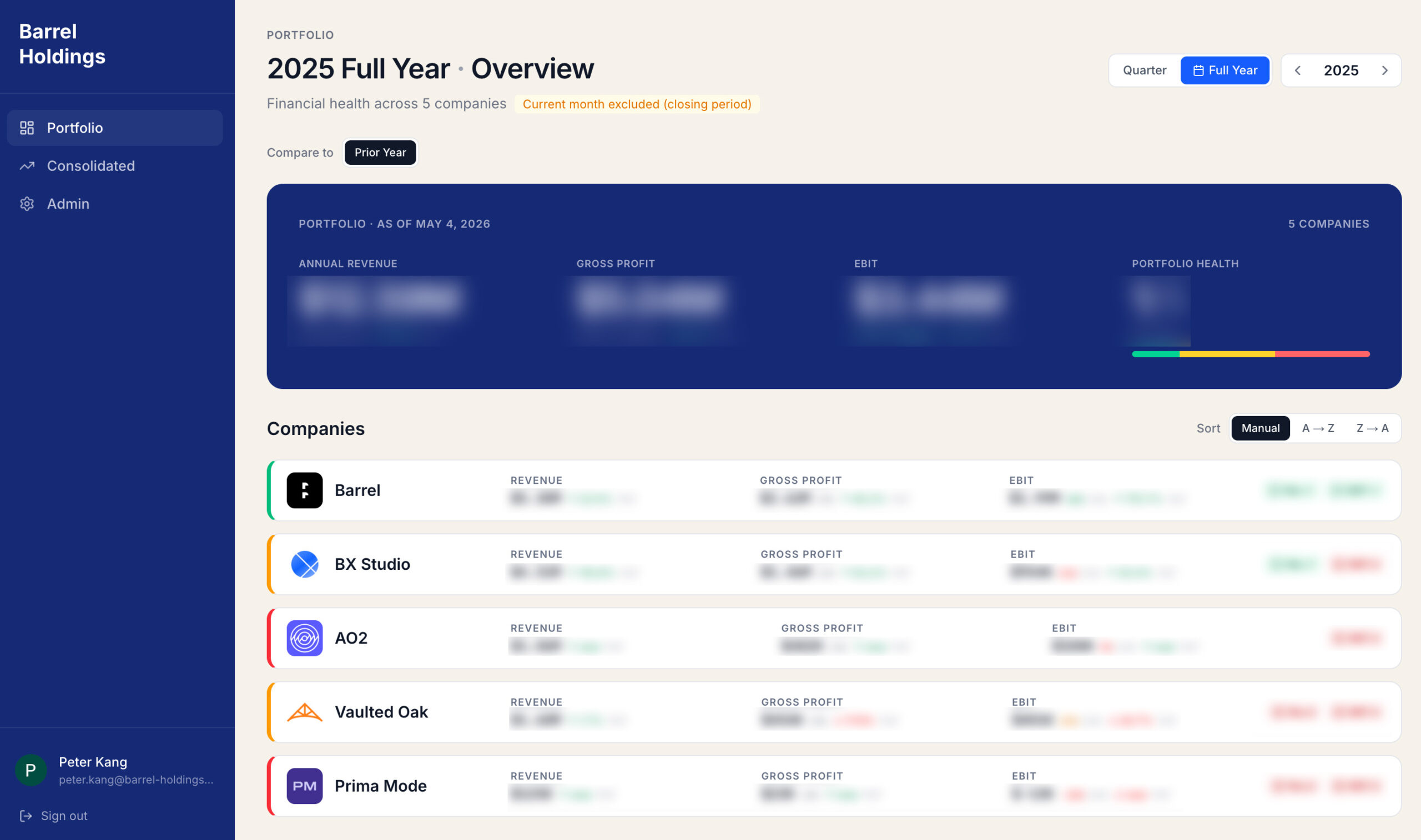
The Barrel Holdings portfolio dashboard gives unified access to our agency finances as well as aggregate holdco stats.
What enabled us to put the dashboard together was the common way we set goals, track client invoices, and manage expenses via Quickbooks. From here, Sei-Wook navigated nuances between how agencies recognize revenue, track sales & marketing expenses, and understand client retention.
Another feature that we’ve just started to scratch the surface of: an on-going AI-generated “fair market value” module that takes various signals from the data and presents a rough valuation on the business. Decreases in gross margin and EBIT, declines in revenue, high client concentration, excessive client churn, and other factors can all play into the EBITDA multiple that gets assigned. We’re continuing to tweak the model so that we can arrive at valuations that roughly mirror our own buy-side work.
What we hope to get from this is a “portfolio yield” view where we can get a figure on how much cash flow an agency generates relative to their fair market value, which would essentially be their yield. And from here, we can see where our agencies fit into the 2×2 matrix of yield vs. growth: high yield/high growth means the agency is compounding and we keep reinvesting; high yield/low growth means we keep harvesting for cash but don’t invest further; low yield/high growth means we’ll want to drive towards profitability relatively soon; and low yield/low growth means we most likely need to cut bait and move on.
A real-time view like this was unthinkable just a year ago. Maybe as a one-off exercise that would quickly be outdated, but what we’re building towards is an up-to-date dashboard that pulls from sources after monthly close and reflects accurate financial data. It’s all very exciting, empowering, and cool to see.
Shared Quotes
“Real strategy lies not in figuring out what to do, but in devising ways to ensure that, compared to others, we actually do more of what everybody knows they should do.” (David H. Maister, Strategy and the Fat Smoker; Doing What’s Obvious but Not Easy)
I think about this a lot when it comes to our agencies: recruit for talent, engage deeply with existing clients, and market the agency proactively to our ICP. All things we know we should do, and yet, often overlooked or put on the backburner.
“We often proclaim whatever we think is missing in another person to be the Most Important Trait. A trait that we believe—or that is in fact—missing in our child becomes the Most Important Trait in a Child. A trait we perceive as missing in our spouse becomes the Most Important Trait in a Husband or Wife. And to make things worse, we then find this trait in other people’s children or spouses.” (Dennis Prager, Happiness Is a Serious Problem)
Try doing this for clients and you get Most Important Trait in a Client and for your employees, you get Most Important Trait in an Employee and you start to see how our personal experience colors the lens through which we see everything.