June was a busy month of focused holdco work. We didn’t have travel or any major transactions/announcements, but there was a lot going on under the hood.
In addition to the ongoing M&A work of speaking to potential agency sellers and evaluating businesses, a lot of our time was spent on various portfolio-related issues and initiatives. Some had to do with performance, some with bookkeeping, some with major personnel decisions, some with comp structures, and some with improving governance practices. There was no day that passed without something to work through.
Midway through the month, both Sei-Wook and I felt a bit frustrated that we had so many loose threads going on across the portfolio, but we just kept hacking away one at a time. By the time the month ended and July 4th holiday weekend was near, we started to feel a weight off our shoulders as many things started to get fully resolved or at least start to have an end date for completion.
With the end of June, we now have the first half of 2026 in the books. We’ll be seeing how the numbers shape up after we close the books on June. And we fully expect a new slate of issues and challenges to pop up in the coming weeks.
The positive takeaway is that months like June really do a great deal to build infrastructure at the holdco. We’ve established some new processes around background checks, partner-level comp negotiations, and quarterly board meetings. And we’ll likely make improvements in the coming months on billing processes and recruiting.
I don’t know when our next deal will happen, and based on what we’re seeing in the market, it’s possible that it’ll be a while before we get to another LOI with a seller. But we’ll use available bandwidth right now to continue to support and add value to our portfolio. A 20-25% organic bump in our portfolio could very well be as accretive as acquiring a new agency.
About Agency Journey: This is a monthly series detailing the happenings at Barrel Holdings, a portfolio of agency businesses. You can find previous episodes here.
Highlights
Barrel 20 Celebration
June 1 was the 20th anniversary of Barrel, our original agency that Sei-Wook and I started in 2006. We had a huge celebration back when Barrel turned 10 years old, but this time around, with Lucas in charge of Barrel and Sei-Wook and I fully focused on Barrel Holdings, we kept it low key.
Lucas and the team celebrated in their own way, with a 20-year edition of Barrel trivia during their weekly virtual team meeting. Lucas also wrote this wonderful piece about what’s made Barrel special to him over the years.
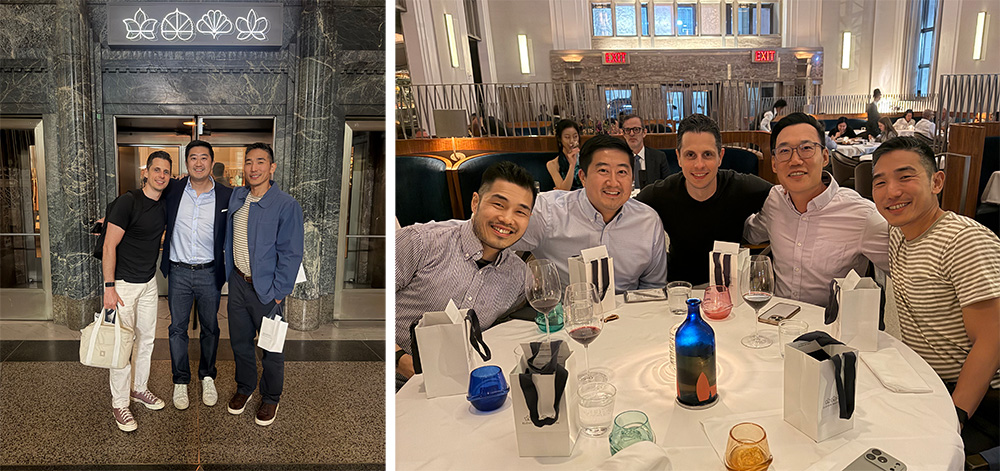
Left, Lucas, Sei-Wook, and me outside Eleven Madison Park. Right, our dinner with our friends Reggie (far right) and Andy.
Sei-Wook and I also met up with Lucas for a nice dinner at Eleven Madison Park to celebrate the occasion. We also invited our friends Reggie and Andy. Andy was our first ever part-time employee at Barrel. Reggie was our ever-present buddy in the early days, making me and Sei-Wook lunch or helping us move offices. Andy now owns his own business, a shed-building outfit in NJ, and Reggie is the executive chef of a very popular restaurant in Midtown Manhattan. It was great to reflect on how far we’ve call come since those early years.
Book Club: The Millionaire Real Estate Investor
Sei-Wook and I met up in NYC to talk about our takeaways and lessons learned from The Millionaire Real Estate Investor by Gary Keller. This is a book that I wish I had read years earlier. It’s got an incredible amount of useful content and models that apply to personal finance and how we run the holdco.
The core premise of the book is that through smart capital allocation decisions (saving earned income, living frugally, and investing wisely), you can own enough cash flowing assets to make a million dollars each year. The path to getting there requires discipline, good habits, belief in yourself, surrounding yourself with a great network, and understanding of how money gets made.
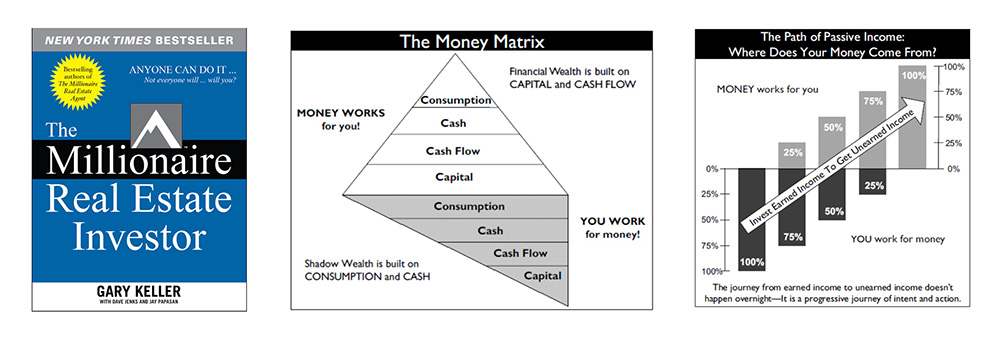
A couple of diagram examples from the book: The Money Matrix shows how money works for you when you prioritize capital and cash flow and how you work for money if you prioritize consumption and hoarding cash. The bar chart on the right shows that the path to passive income is a progression and doesn’t happen overnight.
It’s all very simple stuff on the surface but what makes this book so powerful are the wealth of diagrams that make these concepts very memorable. I ended up screenshotting every single diagram from the book so I could reference them more easily.
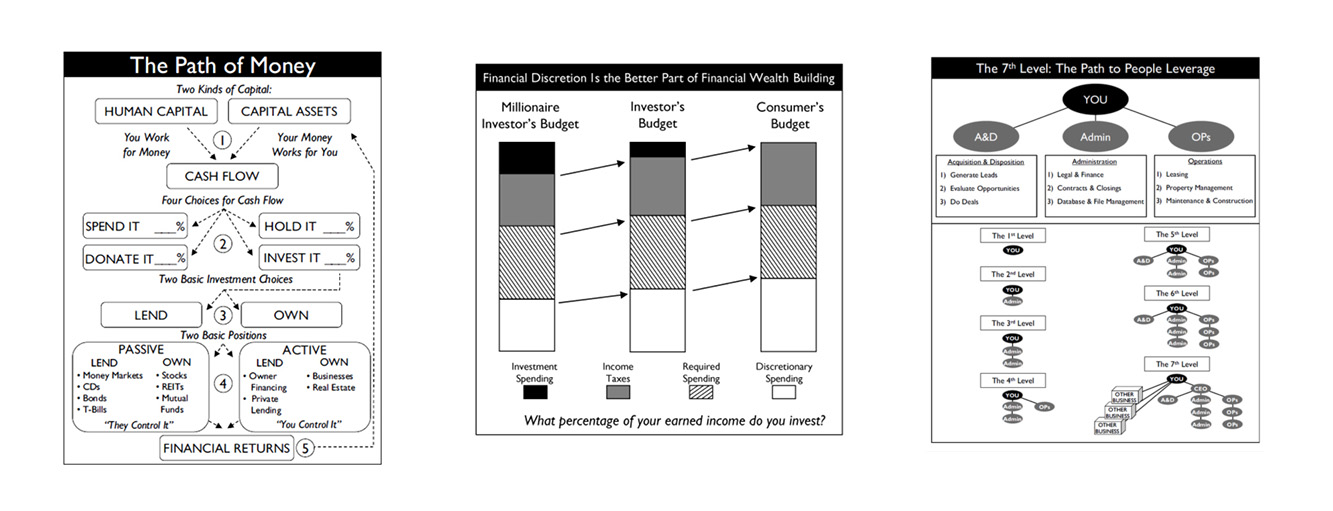
These are a few of the other favorite diagrams from the book.
There were some very specific concepts around defining the investment criteria, building up your “work network”, and thinking about deal structures that were all directly relevant to the M&A activity at Barrel Holdings. I wish I had picked up this book earlier because these concepts would have organized our activities and priorities in a clearer way.
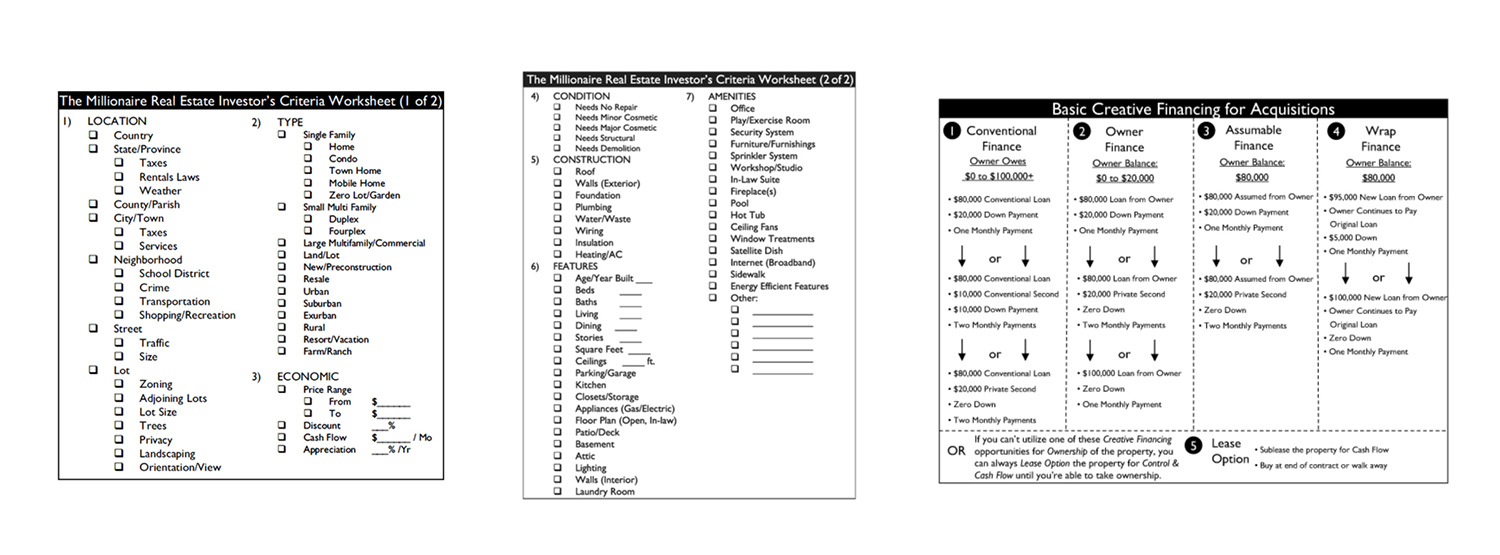
Concepts like defining the investor’s criteria and thinking about creative financing for acquisitions were directly relevant for our Barrel Holdings M&A work.
Sei-Wook and I also tried our hand at applying some of the models and concepts from the book directly to Barrel Holdings. I picked the Work Network diagram to imagine the different relationships and skills we’d need to surround ourselves with. I also chose the Think in Units diagram to imagine how we might develop “groups” within our agency portfolio over time as we do more acquisitions. The book also has the concept of “Receive a Million” which outlines the path to having assets generate cash flow of $1 million. Sei-Wook and I also mapped out what $10 million for Barrel Holdings could look like.
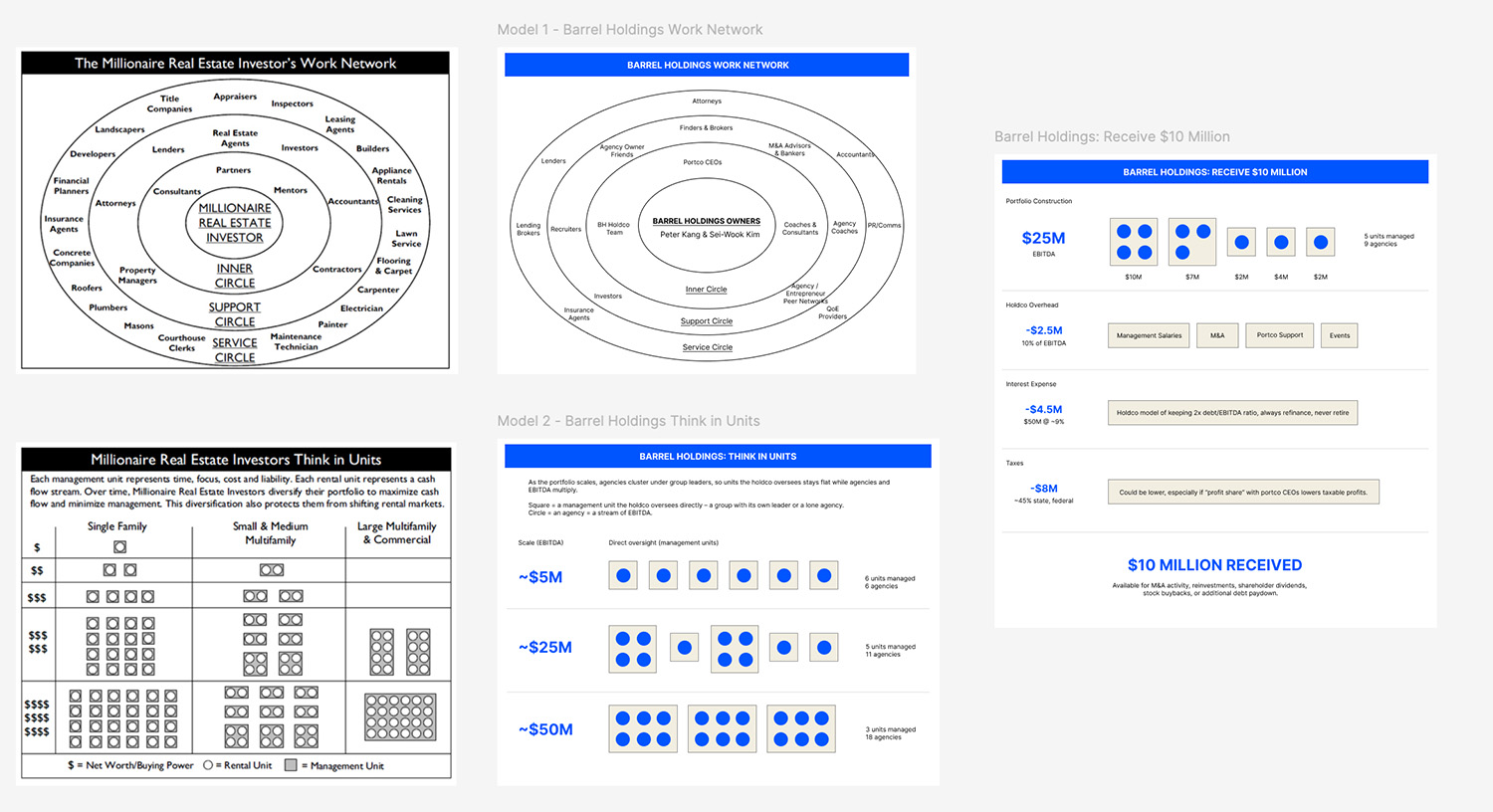
Exercise of applying some of the concepts from the book to make it directly applicable to Barrel Holdings.
The book club is one of the most valuable things we do. It’s always tough to make the time to read the books and then to set aside half a day to discuss it, but every time that we do, we always feel that there’s been a “leveling up” that we wish we’d done sooner.
Hudson Valley Agency AI Forum
James Kravic, a friend who lives nearby in the Hudson Valley and works for a B2B marketing agency, was able to secure space for a meetup in June. He and I had been talking about doing an agency-focused event. We settled on doing something practical around AI and put together programming featuring 4 speakers who would reveal their “AI stack”. James also convinced me that we should set up tables for discussions around different agency topics. AgencyHabits was a sponsor along with Dragon360 (where James works), as well as NewtonX, a B2B market research company.
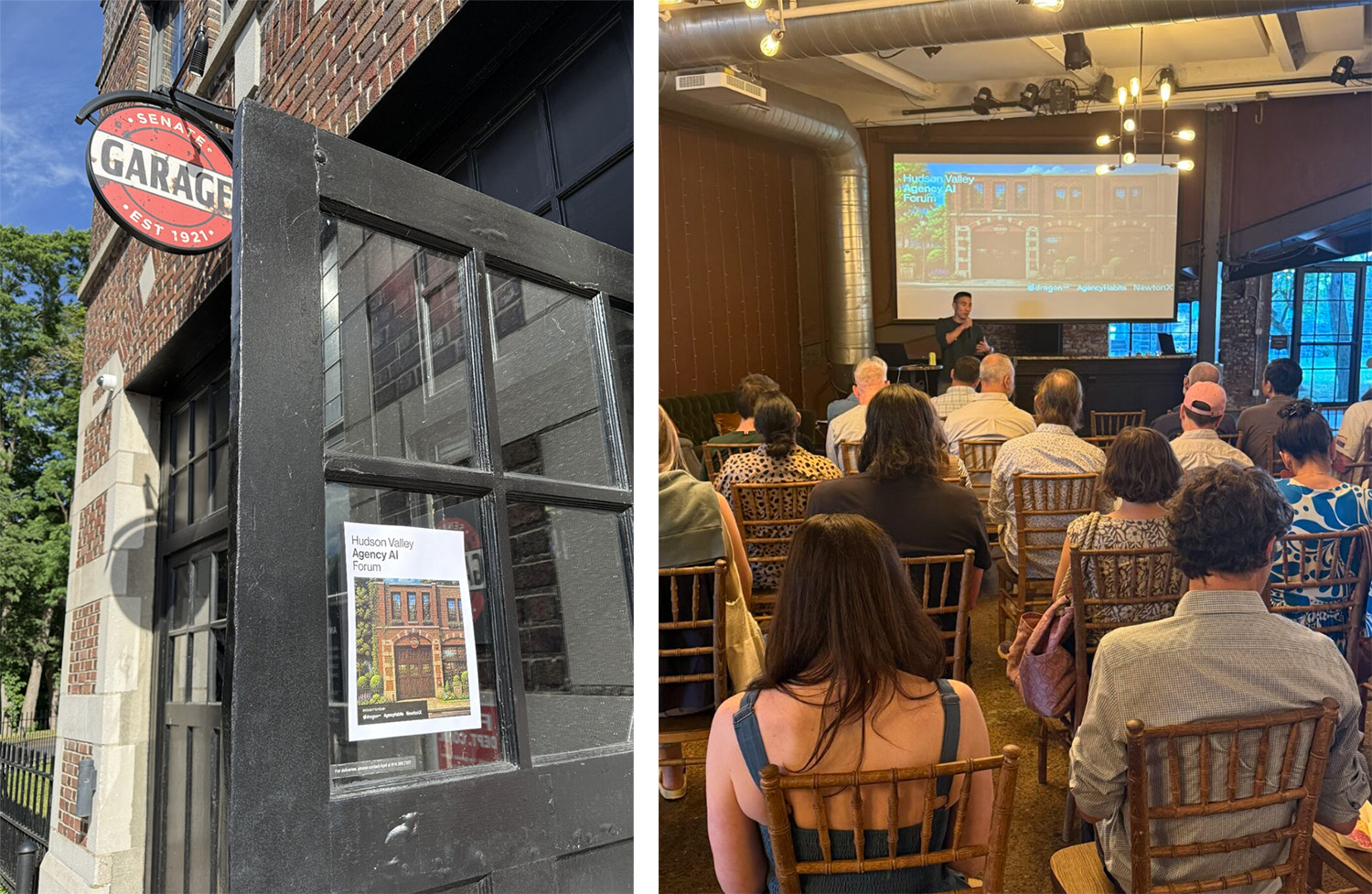
The Hudson Valley Agency AI Forum took place at the Senate Garage in Kingston. Right, that’s me giving welcome remarks to the audience.
We only had a few weeks to prepare and market the event, but to my surprise, nearly 70 people registered. The actual turnout was a little over 40, which was more than I had anticipated. The event went without a hitch, and we got great feedback that the event was really helpful and avoided being just AI hype and fluff.
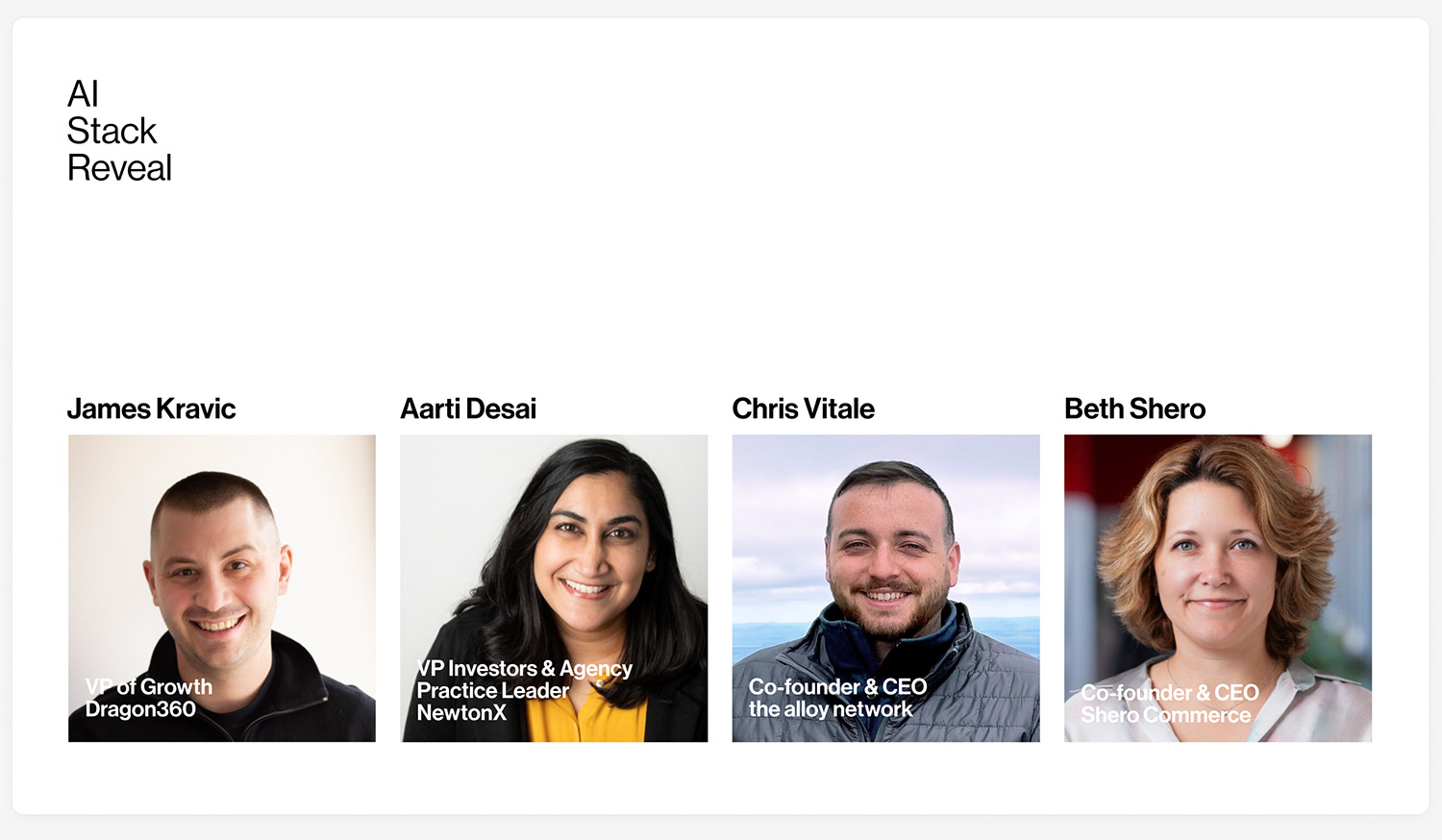
Our speaker line-up at the agency AI event.
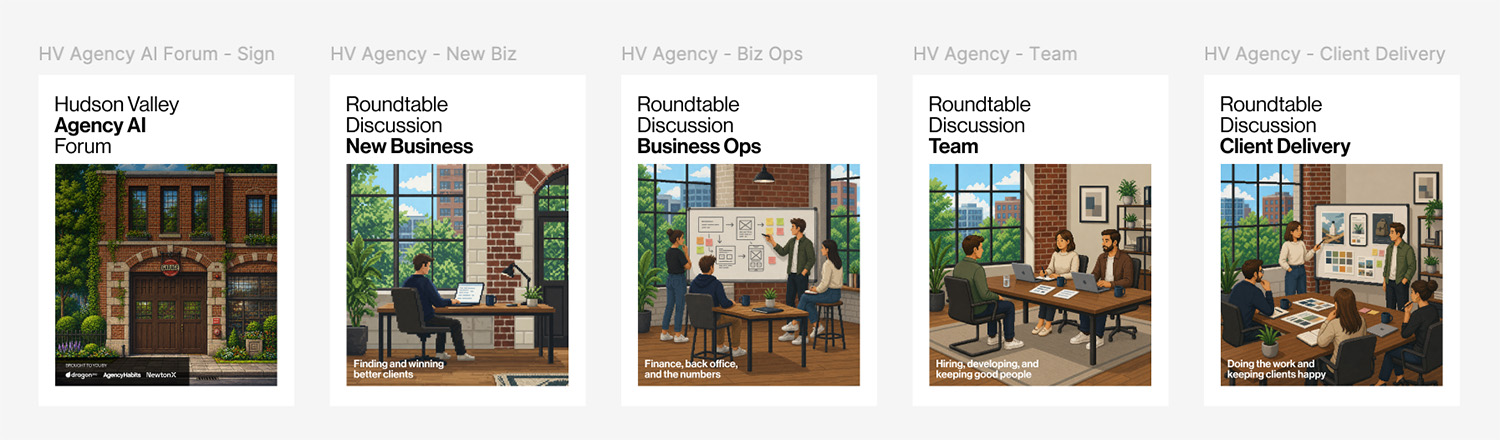
Signage graphics I created on the fly, which we then printed at Staples.
Events are a lot of work and in a low density area like Hudson Valley, it’s hard to tell if we’ll attract enough people. However, being in the Hudson Valley means there’s a lot less competition for attention and community, so I can see an ongoing series of events throughout the year being very sticky.
There’s also the fact that meeting people face-to-face in-person has a very different feel than connecting virtually. For example, I had been introduced to someone near me via email last year. I tried multiple times to follow up via email, text, and LinkedIn DMs, but these were all ignored. This person showed up to the agency AI event not knowing I was the host. We ended up chatting face-to-face. This person then sent me a follow-up LinkedIn message after the event suggesting that we should meet up and hang out, which we did a couple weeks later.
I’ve been lucky to meet and develop relationships via my online activities, but it’s certainly no comparison for the deepening of relationships that happens when you spend time with someone in-person. So if that means doing more events, either here in the Hudson Valley or in NYC and other cities across the world, I’m all for it.
Top of Mind
The Structural Differences of Two Agency Types
A couple of agency archetypes continue to emerge for us as we evaluate potential acquisition targets.
The first one I’ll call the White Glove Boutique. These are firms that typically focus on industry sectors where the clients require deep, long-term relationships with high annual spend. Think healthcare (especially pharma and medical devices), financial services, NGOs/higher ed, and established B2B software. They typically have 10-20 clients with a relatively high degree of client concentration in their top 3-5 clients. They’re doing anywhere between $3 to $10 million in revenue. The founder is still driving most of the new logo wins, but they have a solid team running the existing accounts and retaining their clients (low churn). They have a pretty senior team and high average salaries across the board. They are reluctant to outsource much of their work and care deeply about control over quality. Profitability usually runs at around 20% margin. They don’t get many leads and new logo wins are few and far in-between, but if they can bring on a handful of clients a year, they are in good shape. Every now and then, one of their larger clients may churn because a new CMO has entered the picture or their client was acquired. This introduces a year or two of revenue/profit decreases, but they usually bounce back.
The second archetype is the Quick Serve Boutique. These are firms that focus on small business buyers who need a partner to help them generate leads and grow revenue. Some firms may focus on specific parts of marketing, like building low-cost websites, running Google Ads, or creating marketing materials. Others assume the full funnel and promise to generate leads by any means possible. Local businesses are most likely to engage with such agencies–home services, small law/accounting firms, dental practices, car washes, senior living/home care, child care, etc. These agencies typically have 50+ clients and may even serve 100+ clients per year. Annual contract value may be as low as thousands per year (a few hundred a month). While client concentration isn’t an issue, client retention is always iffy. Small business clients tend to get nervous about the spend and are quick to cancel or pause if they’re stressed about something or not seeing immediate results. Competitors are always swimming nearby, pestering clients to switch over for better results and less cost. There is a lot of pressure to continue to drive new logo sales. The founder is usually really great at closing a bunch of deals every month. Outbound, Google Ads, paid social ads, and cold calling are all viable tactics. The better agencies in this space have a really robust sales and marketing function supported by tight, repeatable systems in delivery that may be handled by an offshore team. Profitability margins could run as high as 40-50%, but revenue fluctuation and customer acquisition costs are real risks. It’s very common for the agency to turn over more than 50% of their client roster in a good year.
Both types of agencies can be successful. We own some agencies that fit the profile of these two. What’s worth paying attention to are a few structural differences:
- These two agencies have very different talent needs. The White Glove Boutique requires seasoned experts who can go deep with a small handful of clients, someones just 1 client at a time. Their creativity and problem-solving on a client-by-client basis is very important. They are likely to be expensive, but they’re also the reason client retention remains relatively high. The Quick Serve Boutique needs very organized client managers who are capable of juggling 10+, sometimes 30+ accounts on their own. Their team is good at setting up repeatable systems and troubleshooting edge cases, but their aim is at efficiency, not depth with each client. They need strong sales and marketing leadership to generate leads for the agency and continually close deals.
- Stability comes from two different sources. The White Glove Boutique relies on high-value, multi-year relationships with their clients, which means client retention is their primary source of stability. A good year is most likely a sub-20% (no more than 3 clients out of 15) churn. And even “churn” isn’t the same for these agencies–a client may simply be inactive for a year only to come back the next year. For the Quick Serve Boutique, stability comes from a steady pipeline and conversion into new clients. As long as the agency can stay even with churn (e.g. lose 4 clients, sign 4 clients in same month), they can maintain their revenue and profitability levels. Stay ahead of churn, then the agency will grow.
In many cases, the grass is greener for both of these agencies. The White Glove Boutique founder would love to win multiple new logos per month and not have to worry about the pressure of doing highly complex work for demanding clients. The Quick Serve Boutique founder would love to have a single client signing a $1 million PO vs. having to sign and service 30+ separate clients for the same amount.
Knowing which archetype an agency belongs to can inform the different investments that can drive future success.
For the White Glove Boutique, it’s about developing and attracting high caliber talent up and down the org to work closely with clients. It’s about embracing the fact that there will always be a degree of client concentration and nurturing the next breakout client who’ll double or triple annual spend. And it’s also about understanding the rarity of leads and slow sales cycle, making the most of each opportunity and playing the long game of cultivating relationships and planting seeds for collaboration in the future.
For the Quick Serve Boutique, it’s about building the machine: an efficient delivery machine that generates immediate results for the client and a sales & marketing machine that consistently brings in a new crop of clients. Talent-wise, there may be a few key systems designers and subject matter experts, but the majority of the roles are in manning the machines and doing the repetitive work of making sure the machine is working. Because client spend is much lower (anywhere from a few thousand per month down to a few hundred), efficiency and cost controls matter greatly in ensuring profit per client.
Some agencies have a murky mix of these two agencies. We don’t love those. It’s hard to focus resources and develop strategy if you’re catering to both. I’ve made the mistake of thinking it would be a good way to hedge. You end up staying small and constrained by the inability to truly invest into one path or another. But it’s a tough chasm to cross–to give up revenue in the short term and commit to a certain way of doing things.
This is why we look for agencies that have leaned heavily one way or another. It’s easier then to pick one and help them continue down that path vs. trying to take one with a murky mix and “fix” them.
Shared Quotes
“The reality of the problem is always less dramatic than the story people have made up about the problem. These catastrophic, panicky stories soon become the problem. When the client looks at reality with me, he usually sees an easy solution.” (Dusan Djukich , Straight-Line Leadership)
Looking at problems with a coach is certainly helpful. Also having the benefit of experience–having seen countless problems again and again–helps to deflate the drama from the situation.
“If you have a portfolio of 10 businesses, chances are that only one will make a hockey stick move over a 10-year period—and correctly identifying that one and feeding it all the resources it needs will most likely determine whether the company as a whole can make a significant move up the Power Curve. This insight about the need to find the “1 in 10” has huge implications for how you run a multi-business company.” (Chris Bradley, Martin Hirt, Sven Smit, Strategy Beyond the Hockey Stick)
I think about this a lot for Barrel Holdings. I know that not all of our agencies will become incredibly successful, and it’s even more likely than just 1 or 2 agencies will drive most of our portfolio’s gains. We need to be disciplined about not throwing money into businesses that are clearly not going to grow. We’ll continue to make bets, but we’ll need to be clear on when to cut off such investments so that we can conserve our time and resources for other more-promising opportunities. Don’t be stubborn, look at the data/face reality, and make tough decisions.