We’re close to completing a deal that we’re very excited about. There are still a bunch of things that we have to get in place and wrap up, but I hope to share some more details in the next episode. A big learning from this deal is the importance of the deal team beyond our core Barrel Holdings team members. This deal was a bit more complex than your standard acquisition, and in hindsight, I wish we had made some different choices with certain types of service partners. I’ll debrief more on the process and our learnings next time, but for now, fingers crossed that we can hit our closing date.
About Agency Journey: This is a monthly series detailing the happenings at Barrel Holdings, a portfolio of agency businesses. You can find previous episodes here.
Highlights
Q1 Quick Takes Across the Portfolio
With March ending, I wanted to give my brief notes on each of our agencies in the Barrel Holdings portfolio (contrast this with year-end update from the December 2025 episode):
- Barrel: Another very profitable quarter with some impressive new logo wins (including Dole’s packaged food biz and sweets brand Albanese). The quarter started off shaky with a major client churn due to service issues and some other clients at risk. CEO Lucas Ballasy has been focusing his energies on strengthening the team through key hires. He brought on a new Business Development Manager as well as strategists in retention and CRO to strengthen delivery. There’s another huge move coming in early Q2 that we’re excited about. Expo West was a success in generating new opportunities and further establishing Barrel in the CPG food & bev space. And Lucas launched his new podcast The Long Aisle, where he interviews CPG founders in it for the long haul.
- BX Studio: The agency worked through some lingering margin pain in Q1, but CEO Jacob Sussman and team have started to turn the corner. Results should materialize in Q2. The biz dev machine at BX has been hunting bigger game, landing larger budget engagements vs. a higher volume of smaller deals. The Optimization team at BX, which provides retainer-like services across CRO, analytics, SEO/AEO, and web updates, has been a bright spot–they exceeded their goals and have been signing deals left and right. Jacob also led a big shift of BX’s positioning from a Webflow design & dev shop to a B2B growth partner that turns websites into growth engines, the thinking being that the initial website build is just the first step and the long-term value creation will come from the on-going optimizations to the website. BX has also diversified their tech stack, now offering sites built on Framer, Claude Code, and Sanity, reflecting the changing needs and preferences of clients and prospects.
- AO2: There’s been a great deal of activity on the business development side, with CEO Jess Wright and CRO Brad Davis along with various team members hitting up a number of conferences to drum up deal flow and raise awareness of AO2 in Q1. It’s been a bit of a slower ramp to signing deals (3 new logos in Q1) and due to some initial calculation errors, AO2 did have to revise down their 2026 goal figures. They also churned 3 clients, but this was offset by the 3 new logos being higher paying, better ICP fits than the ones that churned. The team remains very optimistic about what’s to come in the following months. They have good margins and things seem smooth operationally, so it’s just a matter of gradually increasing revenue over time.
- Vaulted Oak: A handful of wins in Q1, especially on the white-label web development side. I don’t know if Vaulted Oak will grow this year, but I’m fairly confident that revenue will at least get very close to last year, as it has for the past 3 or so years. On one hand, it’s a bit disappointing that Vaulted Oak hasn’t been able to scale as much as I thought it would have after its first 2 years (3x growth), but I’m also not disappointed that the business has maintained fairly steady revenue and profits for 3 years. It’s felt like a very predictable business, something you rarely get in an agency business. And that in itself has some value. I’ll be doubly impressed if VO can navigate the AI impact successfully and, a few years from now, hasn’t experienced volatility in its finances.
- Prima Mode: Still struggling to hit the escape velocity with client acquisition, and still operating at sub-scale versus the other firms. I’ve been having convos with CEO Saniya Aggarwal on sharpening the positioning and narrowing the ICP, perhaps designing services that can better serve the clients that others are not properly serving. They’ll have to keep experimenting until they can hit a breakthrough and really find that “service-market” fit. Their updated website is a big improvement.
AgencyHabits: Working Through The Foundation & Agency Growth Engine Content
We agreed to record 10 podcast episodes to cover the Agency Growth Engine, our framework for business development that we share internally at Barrel Holdings and with our readers/listeners at AgencyHabits.
We’ve recorded 3 out of the 10 (2 in March) that all focus on the Foundation, which is the required groundwork necessary for the engine to have a chance at succeeding. (Note: check out the app we built for generating your agency’s Foundation, and also check out The AgencyHabits Podcast)
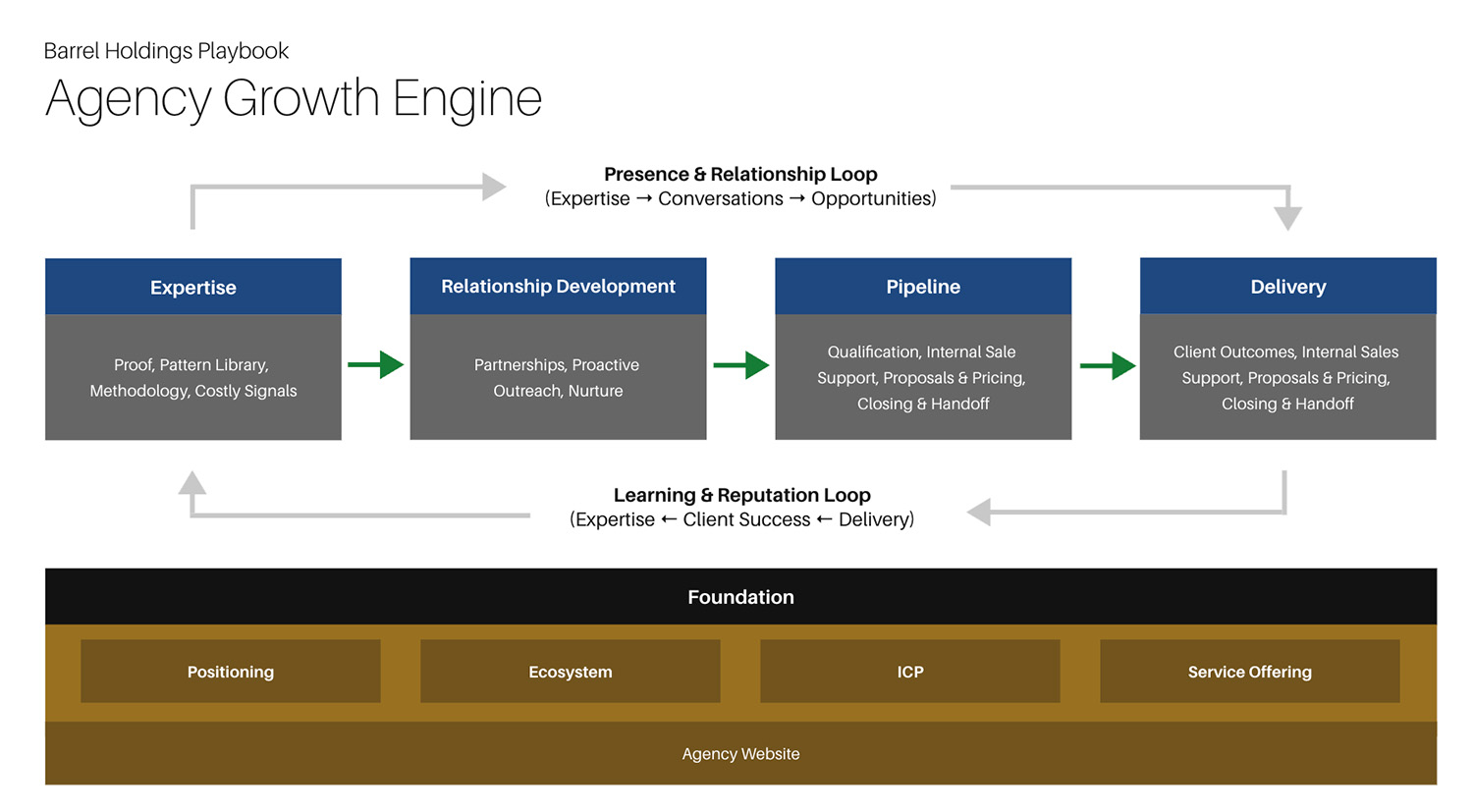
The latest iteration of the Agency Growth Engine, which gone through at least a dozen tweaks over the past 6 months. We’re creating a 10-part podcast series to dive into each of the components in detail.
It’s been a lot of work, but I’ve found the content push to be really beneficial in helping me and Sei-Wook think about business development across all of our agencies and in our M&A efforts.
For example, for the deal that I mentioned in the intro, we’ll be in a similar situation as AO2, where the founder anchoring most of lead gen and pipeline will be stepping out of the business soon after close. This means we need to ensure that the business can quickly fill the gaps left by the founder and develop its own go-to-market motion.
Starting with the Foundation will allow us to align on positioning, ICP, ecosystem, and service offering. This agency already has some really promising qualities across these dimensions, but taking the time to really articulate and write it down will be helpful.
Then going beyond that to identify other gaps in areas like marketing, partnerships, lead qualification, sales close, and client onboarding will provide a clear roadmap to building a more robust Agency Growth Engine.
One podcast that wasn’t explicitly part of the 10 episodes but figures very much into the same theme was also recorded in March: “How to Scale Business Development Beyond the Founder” really speaks to what’s been on our minds. It’s a topic that I find so important that I’ll be giving a talk about this at a conference in May (in Belgrade, Serbia!).
Top of Mind
Thought I’d try something different here. AI continues to be a big part of our weekly convos across our agencies and also between me and Sei-Wook. We talk about the impact on the service delivery model, pricing, professional development/training, client interactions, internal tooling, changes in headcount distribution across different types of roles, etc. But rather than going into another 500 or so words on how it’s both exciting and uncomfortable at the same time, I wanted to share a business parable I wrote about two agency owners who take different approaches to AI. I don’t know who’s “right” and who will “win”, but it made me think about many of the themes being discussed among our portcos as well as with other agency founders.
Two Agencies, Two Approaches to AI
Two agency owners running boutique digital marketing businesses took very different approaches to AI.
Mike saw AI as a chance to make his agency faster, more repeatable, and more productized.
He invested heavily in automation, agents, and standardized workflows across reporting, prospecting, project management, and delivery. The goal was to reduce variability, increase output, and build a business that looked more like a scalable system than a traditional service firm.
And for a while, it worked.
The agency moved faster. Reporting improved. More outbound went out. Margins got better. Some clients appreciated the speed and structure. Mike was responding to something real: a lot of agency work is too manual, inconsistent, and dependent on individual effort.
Sally took a different approach.
She believed AI mattered, but not that speed, by itself, was the goal.
Her starting point was the client: what are they actually trying to achieve, where are they stuck, and where can the agency create more value?
Her team used AI to speed up research, improve preparation, identify patterns, support strategy, and make execution more efficient. They built frameworks, prompts, and pattern libraries that helped the team learn faster and reuse what worked.
At the same time, Sally invested more in recruiting and developing strong client-facing talent. Better account leaders. Better strategists. Better people in the room with clients. She wanted an agency that felt less like software and more like hospitality: attentive, responsive, thoughtful, and easy to work with.
So while other agencies talked about AI transformation, her team kept investing in things that did not always look efficient on paper: more on-sites, more workshops, more strategic conversations, and more time spent helping clients think through tradeoffs.
Nothing about it looked especially flashy.
Eighteen months later, both agencies had learned something.
Mike’s agency was still more efficient than before, but some of the tradeoffs were harder to ignore.
The more the work was shaped around the system, the more some clients felt the agency was optimizing for its own efficiency rather than for the client’s needs.
Some of the tactics became easier for competitors to copy.
A few automation and governance issues created friction. Campaigns went live with errors because no one had fully reviewed them. Clients sometimes received conflicting updates from different reports and dashboards.
The model still had strengths, but it did not solve everything.
Sally’s agency had its own challenges. A more tailored, relationship-driven approach is harder to scale, harder to train, and harder to package neatly. It requires more from the team and asks clients to buy into a relationship, not just a process.
But over time, her approach compounded in a different way.
AI helped the agency become more capable, not just faster. The team got better at applying past experience, spotting patterns earlier, and tailoring solutions to the situation in front of them. Clients felt the difference. The work was more connected to their goals. The relationships were stronger. More of the agency’s value came from how it showed up, how it guided, and how it made the client experience feel.
Both owners embraced AI.
They just built around very different ideas of what an agency should become.
Shared Quotes
“A quick summary is that a terrible industry looks like this: the product is an undifferentiated commodity; everyone has the same costs and access to the same technology; and buyers are price sensitive, knowledgeable, and willing to switch suppliers at a moment’s notice to get a better deal.” (Richard Rumelt, Good Strategy Bad Strategy)
I may have shared this in the past, but worth re-sharing over and over again. It’s very important for our agencies to not fall into this trap, to continue evolving and leveling up in order to be specialized and differentiated experts in the eyes of our clients.
“Don’t fall into the trap of believing you can sell it for a higher price tomorrow. The future is unknown (and unknowable) and fraught with risk.” (Keith J. Cunningham, The Road Less Stupid)
In March, we made an offer to buy a couple of accounts from someone who was looking to move away from consulting in order to focus on building a SaaS business. I thought our offer was reasonably generous, but we were rejected. The response: “For that offer, I could just hire someone to run this and make a lot more money.” I wish them the best and will be checking in on them in 6-12 months. Maybe they’re right and will do really well, or maybe they’ll regret not having taken the deal.
“For local autonomy to work in practice, Judges has had to sacrifice synergies for entrepreneurship. Instead of driving synergies, Judges encourages collaboration between companies, offering them a suite of possible opportunities. This can include market expansion plans, setting up of common locations, or simple administrative functions like common accounting services. As a perpetual owner, Judges provides a favorable environment for its businesses. The only requirement is that the subsidiaries regularly report to the head office on progress. In addition to tracking profit and loss, the balance sheet, and cash flows, the senior management team at Judges Scientific places the highest priority on closely monitoring order intake. They consider this metric the most reliable indicator of how their companies are performing and progressing.” (Oddbjørn Dybvad, Kjetil Nyland, and Adnan Hadžiefendić, The Compounders)
I share this because it’s very similar to how Barrel Holdings operates. We don’t drive synergies, but we do encourage collaboration and knowledge share. And we do require regular reporting of key financials as well as our version of “order intake”, the agency’s pipeline activity, which is a helpful measure of the agency’s progress and performance.