This year felt like a very important year, perhaps a turning point in my career. I fully embraced the role of building a holding company and obsessed with the design of our vision and strategy. We compressed a lot of learnings into a very short period of time, making mistakes, overcoming them, and also having some wins.
Most importantly, I felt like I lived, for the most part, the thing I like to preach often to our agency leaders: be proactive and make the hard decisions before it gets made for you. Whether it was shutting down or exiting an underperforming agency or having tough convos with our portco leaders about their performance, I tried not to shy away or delay as much as I would have in the past.
Heading into the new year, Sei-Wook and I have high conviction in what we are creating with Barrel Holdings. We’re still amazed that we “get to” do this as our full-time job, and we’re seriously motivated to build something worthwhile, one that will provide incredible opportunities and outcomes for our companies and their team members.
About Agency Journey: This is a monthly series detailing the happenings at Barrel Holdings, a portfolio of agency businesses. You can find previous episodes here.
Highlights
End-of-Year Portfolio Update
A quick rundown of our portfolio at the end of 2025:
Barrel
Our CPG Shopify agency had a great year, posting nearly 20% year-over-year revenue growth on very strong profit margins. The CPG focus has been paying off and Barrel benefitted greatly from prospects using AI search. Barrel was able to retain its key clients throughout the year and into next year, often expanding the accounts. The agency also made key investments in sales & marketing, bringing on full-time team members to lead partnerships, marketing, and sales. 2026 will be about continuing the momentum, leveling up talent across key roles and capabilities, and making smart investments in various business development initiatives.
BX Studio
Our Webflow agency had a monster growth year, hitting 100% year-over-year revenue growth. BX Studio was also recognized by Webflow as Enterprise Agency of the Year for its work bringing on brands like Verifone onto the platform. With rapid growth came some pain as existing processes and structures broke. BX experienced a great deal of margin compression in the back half of the year, and it’s had to bring on help to build out new processes and strengthen systems. Things are looking up and the velocity of bookings in Q4 bodes well for the start of 2026.
AO2
We completed our acquisition of our Amazon agency AO2 in the summer of 2025. Since then, it’s been full steam ahead, with a new CEO and fresh mandate to reposition the agency to bigger brands along with some newer Amazon capabilities (e.g. DSP and AMC). We also brought on a Chief Revenue Officer to help build out partnerships and ramp up pipeline for growth. We expect average contract value to steadily tick up as we’ve rolled out newly designed services offering with higher pricing. The new website, which just launched, helps AO2 position itself as a more premium Amazon service provider.
Vaulted Oak
Our website support and maintenance agency stayed flat in growth and dipped a bit in profitability. One major change was the expansion of white label development services for other agencies. This offering, while promising for future revenue growth, has required some upfront investment to ramp up (i.e. some early projects were poorly scoped and not profitable, they’ll learn from it). Once the white label offering gets optimized, it should be an engine for growth as development projects transition into long-term maintenance contracts. In the grand scheme of things, Vaulted Oak still remains a resilient and stable business, not growing but still generating cash flow and retaining clients for a long time.
Prima Mode
Our health & beauty Amazon agency steadily added new clients throughout the year, building a very focused client roster with great retention. While still small relative to our other agencies, Prima Mode is a handful of clients away from finding its stride and experiencing meaningful growth. With our acquisition of AO2, we’ve discussed what the future of Prima Mode might be in our portfolio, something that we’ll work through in 2026.
On the Road
Sei-Wook and I traveled to Oklahoma City and Missouri (St. Louis and Missouri) in December to meet with some agency owners. I’ve always enjoyed visiting different parts of America, getting a feel for the vastness and to notice the many similarities (big box retailers, fast food chains, etc.) and differences (terrain, traffic patterns, population density, demographics) that each place offers.
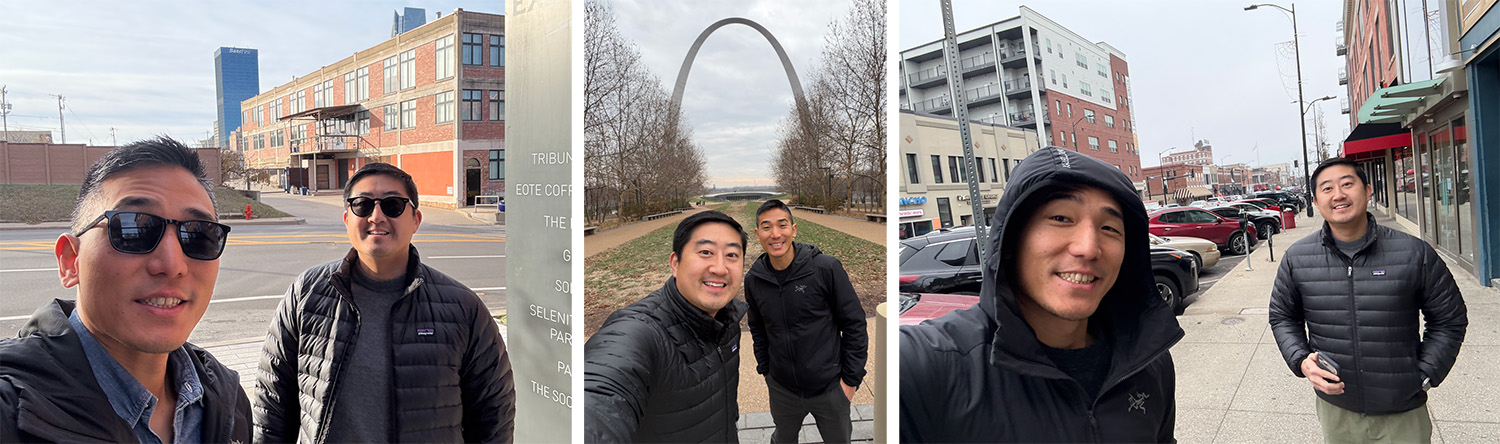
Sei-Wook and I headed out to (from left to right): Oklahoma City, St. Louis, and Columbia, MO to meet up with agency folks.
We enjoyed good eats and conversations with agency owners about successes and challenges they experienced in their respective agencies. We shared what we were seeing across our portfolio of agencies and what we hoped to accomplish with our holdco.
I hope Sei-Wook and I have more occasions to do trips like this in the future. Many of our future trips will be spurred on by M&A activity (e.g. meeting face-to-face with potential sellers), but that doesn’t have to be the only reason. We even met up with one of my newsletter subscribers who happened to live in St. Louis and was down to talk shop about his agency business.
The in-person meeting is always a great opportunity to establish trust. It is always more memorable than any video call. Taking the time to get on a plane and meet with someone is a sign of seriousness, whether it’s to explore an acquisition or to establish a partnership. These meetings don’t have to lead to a commercial outcome. They can be the beginnings of a long term friendship or, at the least, another person to cheer for and receive cheers from.
Top of Mind
How to Think About Agency Growth
One topic that’s been top of mind the entire year is agency growth, as in, how do you get an agency to grow?
This is perhaps the #1 comment we get from prospective sellers, especially the $2-$5 million annual revenue agencies we most commonly see: “Our agency does great work, we have amazing clients and a talented team, but we just haven’t been able to grow. We need more opportunities.”
It’s as if everyone’s problems would be solved if they had a handful of more qualified leads each month.
But having been in the game long enough and observing our portfolio of agencies, it’s clear that growth isn’t just about having more leads. It’s about having various facets of your agency working together to generate growth momentum. We call this the Agency Growth Engine and, predictably, it’s a ton of work that doesn’t immediately produce results but takes patience and persistence to get going.
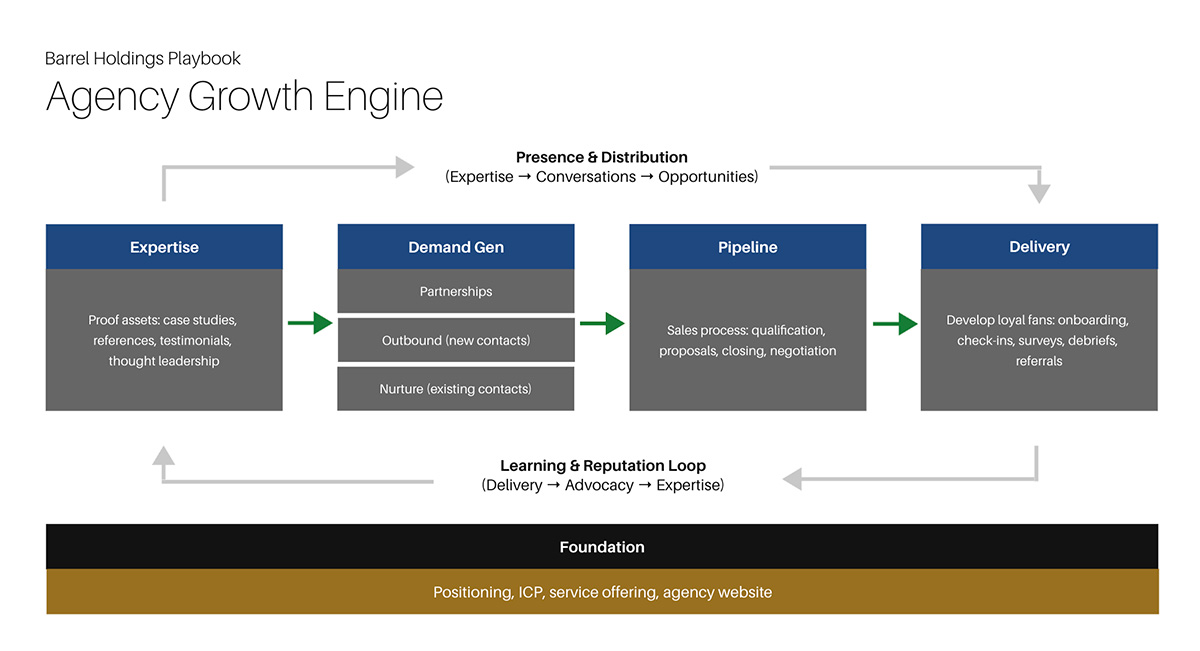
The Agency Growth Engine model shows the holistic effort required to generate quality opportunities in a sustainable way.
Rather than describing the Agency Growth Engine model, I want to share a made-up scenario for an agency and talk through how the Agency Growth Engine components can be directly applied. Here goes:
Dave is the owner of a digital marketing agency that’s done between $1 to 2 million in revenue the past 4 years. His best year was $2 million a couple of years ago but this dipped down to $1.7 million in the past year.
Dave is eager to get the agency growing and is ready to do what’s necessary to make it happen. His first order of business is attending to the foundations and figuring out the basics: who is his agency serving, what problems does the agency solve, and what makes his agency different? Dave audits his client roster and realizes that his agency has been all over the place. They’ve done marketing for consumer brands, B2B tech companies, insurance, financial services, home services, and more. While certain skills have transferred from account to account, Dave can feel that his firm has been a mile wide and an inch deep.
Working with his team and with an eye towards the future, Dave decides that the agency will start to positioning itself as a lead generation agency for professional services firms. Dave recognized that his agency had a cluster of quality clients in the financial, legal, and creative services space and that his team was especially good at building lead gen systems through advertising, content, and website builds.
Dave knew that he couldn’t just jettison his non-professional services clients overnight, but he wanted to make sure that 100% of his agency’s business development efforts were now laser focused on this new positioning. Dave and his team went further in mapping out the ideal client profile (ICP) including the roles of buyers at these firms and their buying triggers. They crafted key messages and value propositions to be used in sales convos and marketing materials. They overhauled their services offering to focus on the lead gen activities and priced in a way to avoid hours, leaning into both fixed and outcome-based pricing. They designed a brand new website that only featured case studies and services tailored towards their new ICP.
Dave told his team that this was only the beginning. They would need to develop a habit of generating proof assets that demonstrated their expertise. Dave committed to writing thought leadership, posting multiple times a week on social media talking narrowly to his ICP about their problems and potential solutions they could adopt. The team created processes to ensure that newsletters to clients and partners went out monthly and new case studies got published quarterly, keeping the website fresh and focused.
Dave also brought on a part-time partnerships lead who could help him organize, prioritize, and stay in touch with their various partners. This included various tech and channel partners that the agency brought customers to and who could funnel leads to the agency. It also included branding agencies and fractional CMOs that could be mutual referral partners. The key was to stay alert, bring opportunities to the partners, and stay top of mind through periodic check-ins. What used to be a couple leads per quarter turned into dozens of leads once Dave and his partnerships lead started systematizing the process and staying consistent with the inputs.
Dave also came to believe that filling his funnel with new contacts was an important investment, even if the time horizon to land them as a client could be as long as 2-3 years. In addition to boosting his social media posts to relevant audiences, he also enlisted an outbound agency to send email and LinkedIn message campaigns to the agency’s ICP. Knowing that 90% (or perhaps more) of these contacts would not be in market to buy his services, Dave made sure the messaging wasn’t about hiring his agency but focused on delivering some kind of value–a free digital marketing guide, a marketing benchmark report, access to a free audit tool, invitation to an educational webinar, etc.–so that the recipients would opt in and start the process of being nurtured.
For Dave, the nurture piece was key to creating high quality opportunities. He invested in various activations like in-person events, lunch and learns, and glossy printed reports in addition to the usual email, text, and social media pushes to stay top of mind. Sure enough, as these activities took hold over the course of 2-3 quarters, those initially not-in-market to buy eventually became interested, converting into qualified leads.
There was nothing more wasteful, in Dave’s mind, than a lead that was poorly handled during the sales process. Dave hired a sales consultant to help audit the agency’s processes, refining scripts and steps to ensure a great experience for prospects. The agency tightened their qualification process based on the positioning, enhanced their proposals, and streamlined the various touchpoints and conversations that could improve win rates. Conversations around pricing and terms as well as MSA/SOW negotiations were also carefully considered and mapped out, helping Dave guide prospects more smoothly through the sales process. And later on, when Dave hired his first business development manager, he was able to provide training materials and guidance on all these aspects of agency sales that had been thoroughly thought through.
All throughout this transformation of his agency, Dave knew that no growth was possible unless the agency made good on its promise to generate leads for its clients. This was why he entrusted the agency’s delivery system to Candice, his trusted COO, who was maniacally focused on generating results for clients and keeping them satisfied. Candice saw successful delivery as the outcome of two inputs: great talent and proactive communication. In addition to hiring skilled team members, Candice instituted strict accountability measures and in-depth training to ensure that each person performed to standards. Those who struggled to keep up and improve were quickly replaced. Candice invested in building out a bench of contractors and junior talent, well aware that the agency needed to avoid being stretched too thin which would inevitably lead to balls being dropped on client work.
Candice also worked with the team to create a seamless client experience that started off with a well-organized kickoff and onboarding and various communication channels and cadences throughout the engagement to keep the client in the loop. Project schedules were immediately updated if things got pushed. Clients were encouraged to provide feedback through NPS prompts and more detailed surveys. The team made it a point to conduct debriefs at the end of every engagement, taking lessons and turning them into new processes.
Lastly, but certainly not the least, Candice made sure that what the team delivered for their clients was measurably impactful. For their clients, the volume and quality of leads generated was of the utmost important. The agency kept dashboards for their clients to
Through these efforts, retention would remain extremely high, allowing new clients to grow revenue rather than replace churned client revenue. By delivering for clients, the agency is not only able to generate great case studies, but are also able to ask clients for testimonials and to be references for future prospects. And best of all, as more and more clients experience success with the agency, they become a reliable channel for warm referrals that typically end up converting.
In delivering at a high level for clients, the team continues to deepen their expertise. Whereas before with a less focused client roster it was hard to go deep, the focus on lead gen and professional services firm has allowed the agency to develop stronger POV, new processes, and proprietary tech. Dave has more success stories and specific cases he can share on social media. Continued delivery enriches the agency’s expertise and a flywheel begins to develop.
At the end of the first year of committing to building this growth engine, Dave’s agency logs modest growth, going from $1.7 million to $1.8 million in revenue. But underneath the hood, there are a lot of changes going on. More of the $1.8 million is composed of the professional services firms that the agency is targeting. Better yet, the profit margin starts to tick up as the agency experiences efficiencies in serving similar clients.
It’s in year 2 of implementing the growth engine that things begin to materially change. Lead volume, qualified leads, and wins all start to tick up. Clients are finding the agency through AI search, social media, and partners. The outbound activities provide steady growth to the agency’s newsletter and events. By the end of year 2, the agency is beginning to book new business at record levels. They’re able to blast through the $2 million ceiling. By end of year 3, they’re at $4.5 million with no signs of stopping.
None of this was linear or easy. There were plenty of setbacks and broken processes along the way. But Dave and team stayed committed to the idea of building an engine vs. looking for short-term hacks. They never let up on making continuous improvements and keeping the success of their clients top of mind.
For Barrel Holdings, the Agency Growth Engine model reminds us that it’s near impossible to take over a struggling agency, make a few changes, and expect growth to happen right away. We have to find agencies that already have parts of this engine working. Preferably, the Delivery and Expertise components have “good bones” and give us something to work with. We can support leadership in refining the Foundations and then encourage them to invest in the Demand Gen and Pipeline areas. But this still requires competent, motivated, and resilient leaders who’ll really grind it out to get the engine into gear. If the agency we acquire don’t have such people or have trouble recruiting them, then it’ll remain stuck, oscillating between “bad” and “okay” years but never being able to stack consecutive great years.
Shared Quotes
“In an organization, the ‘culture’ and floor are ultimately one and the same. The culture is the agreed-upon level of transparency and accountability in the system. When you raise the floor, you raise the culture—who is in the organization, what the expected performance is, what the consistent results are. To scale, you’ll need people who want to be held accountable, who are willing to fully expose themselves, especially in their mistakes. Are you willing to raise your floor? Are you willing to cut everything from your system that can’t or won’t reach the vision you’re committed to?” (Benjamin Hardy, Blake Erickson, and Tony Robbins, The Science of Scaling)
Love this. Made it clear above in how the fictional agency is able to gain operational leverage.
“Just because somebody asked you a question doesn’t mean you have to answer it. Dramatic people are fueled by reactions. When you stop reacting, they go away. Same goes for yourself. Your emotions insist they need you to respond. When you ignore the urges, they go away too.” (Derek Sivers, How to Live)
Reminds me of the adage that while you can’t control everything, you can certainly control your reaction to a situation. This type of mastery is invaluable.
“In dealing with employees, I have found one universal truth: They all want to be successful. The key is alignment on definitions of success. As a business Owner and leader, you must answer this question: What has to happen in order for this employee to be successful at his or her job? The clearer we are on the coaching of beliefs and performance by shifting the burden of ownership and correction to the employee, the less the likelihood we will have to resort to begging, threats, and consequences.” (Keith J. Cunningham, The Road Less Stupid)
This framing is something that I need to be reminded of again and again. People want to be successful, and a good leader designs the role and experience to facilitate success.
Enjoyed this piece. The fictional agency gave me lots of ideas and motivation to be more meticulous for documenting processes and be laser-focused in my work. Thanks Peter.
ps. love the visual of the Agency Growth Engine!