January was a bit of a blur for me, so much so that I had trouble figuring out what to write when I started to put an outline for this episode together.
I decided to ask Claude Cowork to help me come up with some ideas. I first had it read my past Agency Journey episodes to get a feel for the format. I then told it to check my Google Calendar, LinkedIn posts, and my Day.ai call recordings for the month of January to then come up with an outline.
A few minutes later–boom–I got a very comprehensive outline. I had totally forgotten about 70% of the things it surfaced for me. I picked a few of the topics and that’s what I’ve riffed off in the following sections.
It’s still very much me writing and reflecting on these topics, but the fact that the tool can help surface details and ideas that I’ve forgotten is incredibly helpful.
About Agency Journey: This is a monthly series detailing the happenings at Barrel Holdings, a portfolio of agency businesses. You can find previous episodes here.
Highlights
Hanging at NRF, Reconnecting with Shopify Agency Leaders
I decided to check out the National Retail Federation expo at Javits Center in mid-January. I had it circled on my cal because I thought a couple of our agencies would be attending, but that wasn’t the case. I went anyway to catch up with some agency friends.
I hung out mostly with Midknight Genius founder Jason Sidana around the Shopify booth. Got to see John from Avex, Mac from Domaine, Jon from Syatt, Eric of SLTWTR, Chelsea from Sunny Road, and several others from the Shopify ecosystem. It was nice to catch up with these battle-tested agency leaders, many who compete with each other and with a bunch of others coming in and out of the mix.
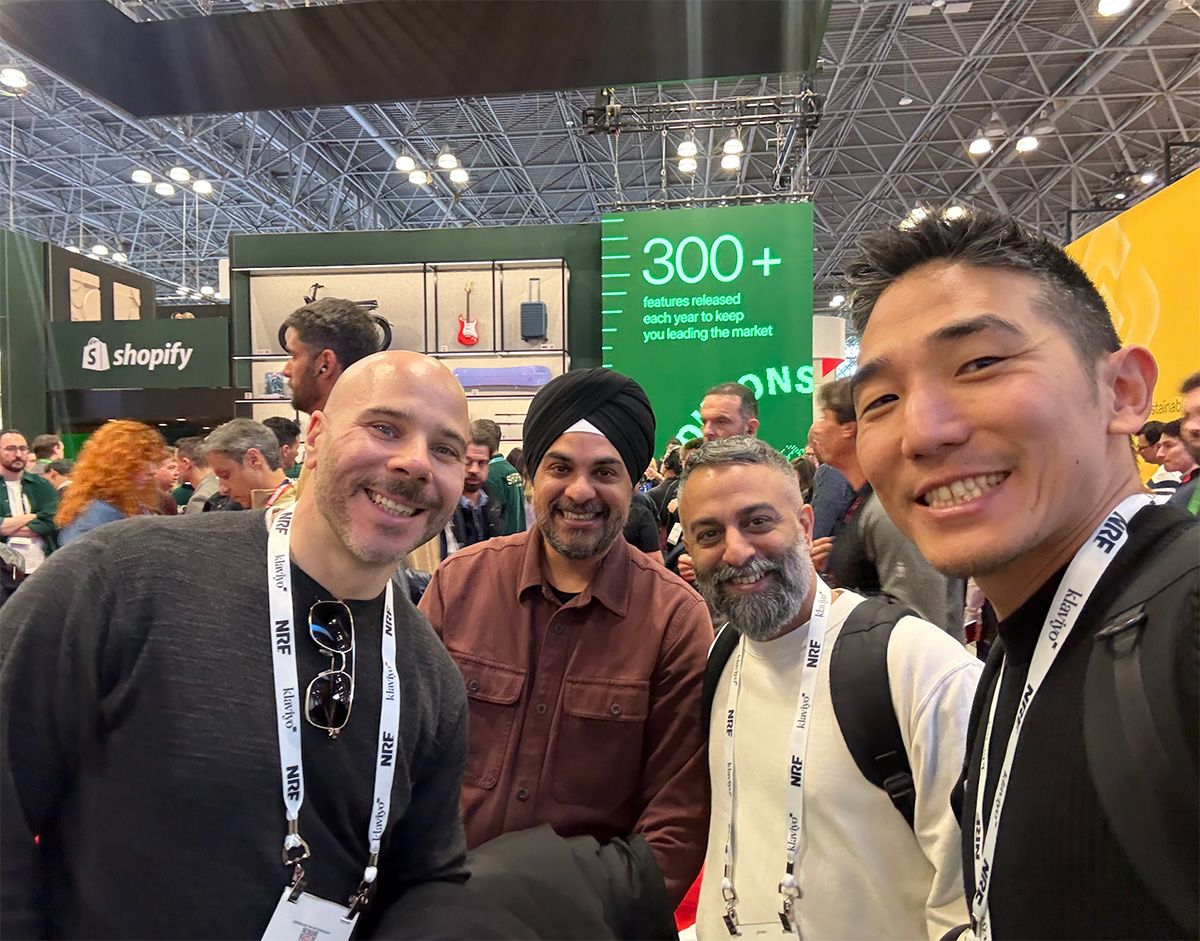
Hanging with some Shopify agency friends (left to right): John from Avex, Justin and Jason from Midknight Genius, and me, standing in front of Shopify’s large exhibit.
Some expressed fear and uncertainty about AI and how it might impact their value to clients. Others leaned more optimistic and thought there was more opportunity for growth. Whichever way, my common observation was that being an agency leader in this space is no cakewalk. Everyone hustles hard and are always contemplating some kind of an exit “in 2 to 3 years”. I’ve heard some of these people say this every year over the past 5 years. Some of them actually do exit, but others keep trucking on.
Building Useful Software with Claude Code
I’ve been on a kick lately with Claude Code. In January, I launched a couple of apps directly related to AgencyHabits.
The first is the Foundation app, which turns the principles of our agency positioning framework into an interactive tool. You simply have to insert your agency’s URL and/or PDF and the app does its best to extract and interpret the positioning while also suggesting some ideas to fill in the gaps. What I want agencies to get out of this is the importance of going a few levels deeper to think about ICP, ecosystems, and buyers with greater specificity. This way, they can better hone their business development efforts.
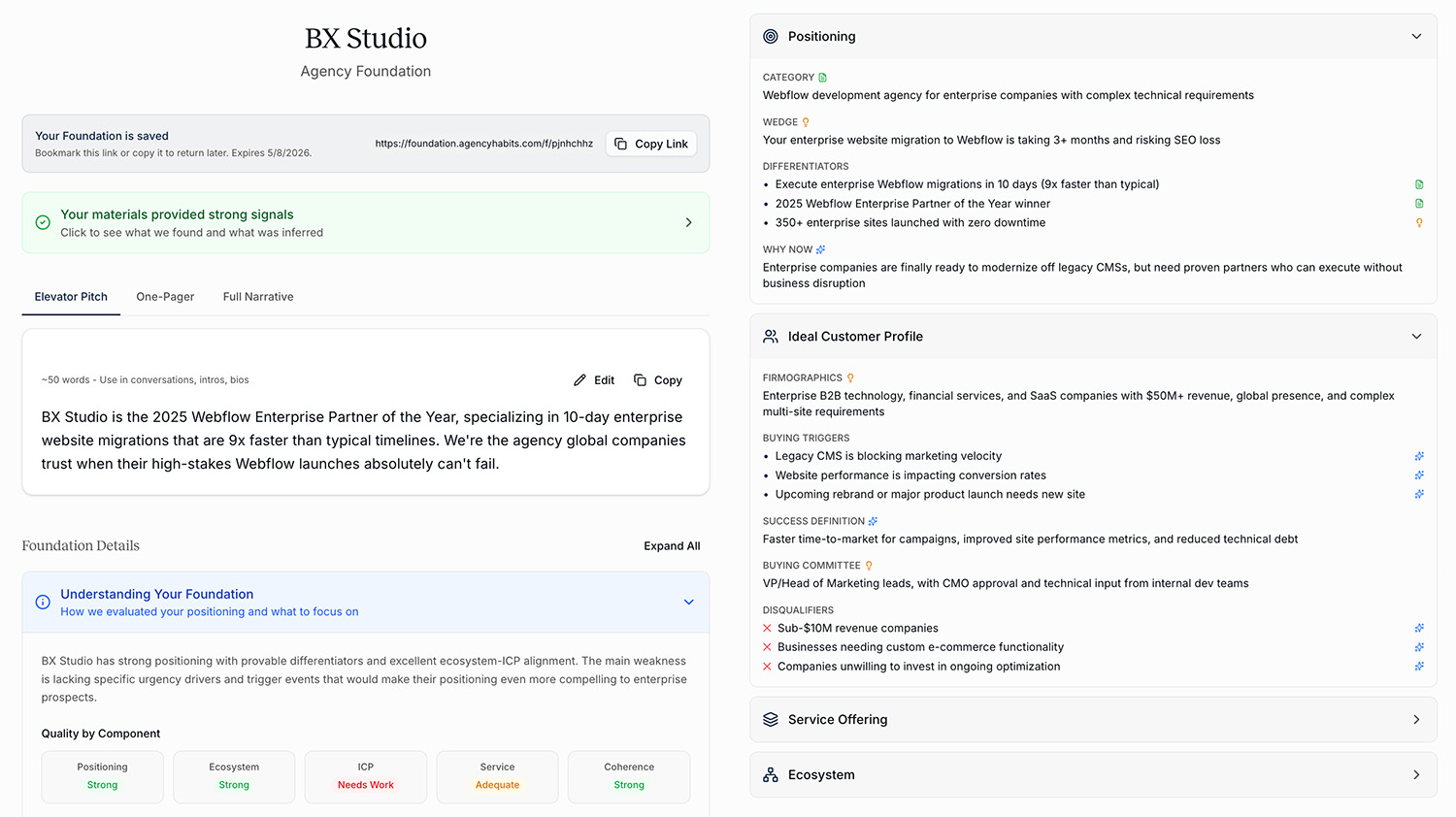
The AgencyHabits Foundation app is the interactive manifestation of a framework we’ve developed for agency positioning.
The other app is a Knowledge Base for The AgencyHabits Podcast. While recording in January, Sei-Wook and I remarked how it would be nice to easily look up episodes to mention based on topic. Since we have transcripts for all our episodes, I was able to quickly build a chatbot interface to query and get answers. But I went a few steps further and layered on some AI firepower so our podcast transcripts could be the basis for content ideas based on the queries (e.g. what are the top qualities of an agency leader?), synthesizing multiple podcasts to produce coherent answers. I also built an admin interface to see what queries users were making, which is now a great way to figure out what topics to talk about in future episodes.
Beyond myself and AgencyHabits, some of our agency leaders have been really getting into Claude Code (CC) and building agency-specific tools. Jacob at BX leveraged CC to build a client call monitoring system that quickly analyzes client sentiment on calls from recordings and posts updates in Slack with summaries, warnings, and next steps. He’s also got one for sales calls as well. Lucas on the Barrel side found a way to pull in financial data from spreadsheets and designed a beautiful dashboard with account-by-account breakdowns and forward-looking revenue projections.
The explosion in creativity and custom tooling is really exciting. From speaking to other agency leaders, it’s happening everywhere. Those that adopt and continue to evolve their AI-powered tooling to drive productivity gains and extra value for clients are going to be in a good spot.
Takeaways from Networking with Biz Dev Folks
In early January, I shared a post on LinkedIn looking to connect with people who were focused on agency business development:
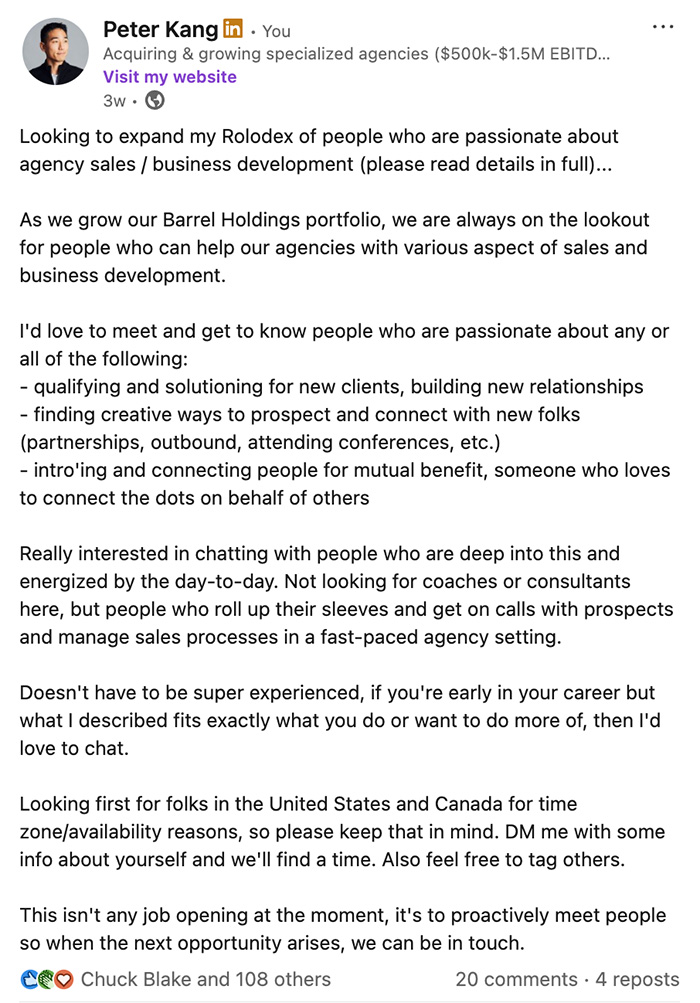
I shared this in early January and instantly got an avalanche of interested BD folks looking to share their POV.
I spent the next few weeks on a fact-finding mission talking to agency founders, fractional BD consultants, and sales leaders to understand what’s actually worked for them when it comes to agency business development. I’m grateful to these people for their time and generosity with knowledge sharing. A few themes kept coming up:
- Founder-led sales is a real competitive advantage, but you need a plan to partially systematize it. Prospects respond dramatically better when they’re talking to someone who does the work. One agency owner reported a 40-50% close rate largely because he handles sales himself as a strategist, not a salesperson. The challenge is figuring out which parts of the founder’s sales motion can be handed off. Arming junior people with intelligence backgrounders and templated materials so they can “talk director-speak” is one way to scale founder-level quality without the founder in every room.
- Separate inbound and outbound BD roles. This came up repeatedly. When one person handles both, inbound always wins because it’s more urgent and outbound prospecting dies. Our own agencies learned this the hard way. Multiple people confirmed that splitting these functions, even if one is just a part-time support role, is how you protect the long-term pipeline.
- Low-volume, high-relevance outbound beats volume plays (with one notable exception). Most agencies seeing results do 25-50 deeply personalized touches per month across channels matched to their ICP (Instagram DMs to CPG founders, handwritten notes, LinkedIn with actual personalization). The exception: one agency runs two reps making 100 cold calls per day, funnels prospects into webinars and a free book download, and converts 1 in 4 discovery calls, but they’ve built an entire educational sales machine around it. The lesson here is that the BD motion has to match the ICP and the sale.
- Ecosystem partnerships are the highest-leverage BD activity. The best agencies aren’t waiting for partner referrals. Instead, they’re creating vertical-specific content and proof points that make it easy for partner sales teams to refer confidently. One Shopify agency adapted their messaging when Shopify’s sales comp changed from quick closes to post-launch growth metrics. Another agency became “the tip of the spear” by generating demand through narrative and storytelling work, then referring execution to specialized partners (over $500k in referred business to just two partners last year).
- Get sharper on ICP as most agencies are still too vague. The best operators define ICP down to the size of the prospect’s marketing team, specific buying triggers, and clear disqualifiers. One BD leader flatly refuses to work with owner-founders (“they’re all erratic, their ego is within the brand”) and exclusively targets marketing managers at established companies. Another targets portfolio brands’ neglected sub-brands as an entry point, starting small and growing to handle near-entire portfolios without competitive pitches.
- Timing matters more than persuasion. Average agency close cycles can be 200+ days. The agencies with the best conversion rates maintain systematic nurture lists (e.g. monthly check-ins with genuine value, not “just touching base”). One person described reaching out to the same prospect across multiple channels for three to four months before they finally come inbound. The key is to stay in orbit until the timing is right.
- Turn project work into strategic relationships. Several conversations touched on the trap of project-based work: it has an end date, and then you’re chasing the next thing. The move is to frame projects as pilots, get a seat at the strategy table, and find the “unsexy but valuable” ongoing work (maintenance, optimization, audits) that keeps you embedded. One person turned a tactical IT relationship at a Fortune 500 into a $1.6M annual deal by creating a shared client-agency roadmap that consolidated a fragmented vendor model.
- Specialization is the unlock for everything else. Whether it’s a vertical (home services, food & beverage, medtech), a platform (Shopify, Webflow, Braze, Amazon), or a service niche (narrative strategy, experience design), the agencies with the clearest positioning have the most focused BD efforts, the easiest partner conversations, and the most efficient conference strategies. As one BD director put it: agencies that try to be everything end up where “people don’t know who they are, nor do they have any clue what they offer.”
I learned some new things and also came away feeling good about how we’ve been thinking about agency growth and business development across our Barrel Holdings agencies.
Top of Mind
Once Again (Or As Always), It’s All About Talent
In January, I attended a dinner in Manhattan hosted by entrepreneur Pete Sena. My agency buddy Sam Shepler of Storysnap invited me.
At the dinner, I met Dom Farnan, a seasoned recruiter who had just helped Groq (recently acquired by NVDIA) scale up their team as an internal recruiter for the past few years. We talked about the importance of talent, especially in a competitive environment as Silicon Valley during these AI boom years.
Dom mentioned an article by Seth Godin on the difference between hiring and recruiting. It’s an incredibly short post, so I’ve pasted the screenshot below, but it gets right to the point about why recruiting is so important for attracting the best talent.
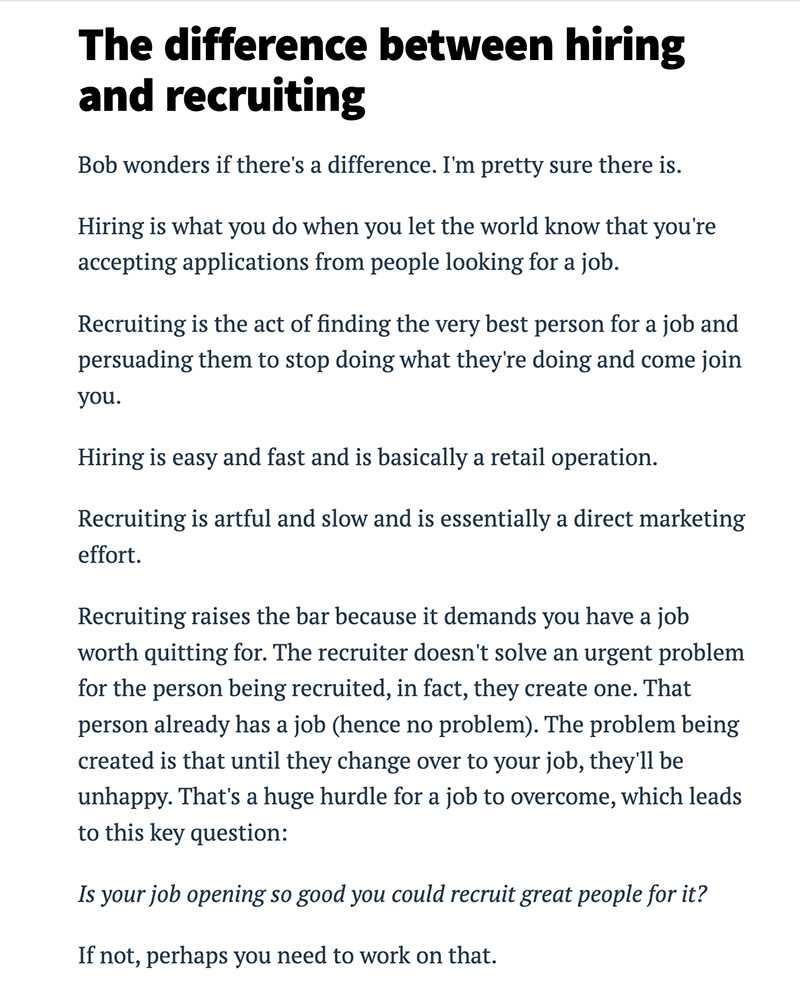
The difference between hiring and recruiting by Seth Godin, from seths.blog
I thought about this implication across our Barrel Holdings agencies and realized that for most, we defaulted to hiring. It was only when things got busy and tight, that we’d shout for help and try to process applicants in a reactive way. Our teams did not deploy nearly as much resources or attention to patiently scouting and nurturing talent for the future. A big opportunity for us.
The few instances where we did spot talent and cultivate a relationships and eventually brought that person in, the leverage and upside has been immense. It absolutely pays to be proactive when it comes to talent. And part of it is getting the story about the opportunity and the vision right and the other is being able to find and meet talented people who may one day be interested.
As with most things, taking the long-term approach and doing the harder thing usually leads to the most impactful results. In the agency business, it’s always been about the people. Maybe the overall headcount numbers may fluctuate (or trend downward) due to the impact of AI, but the strength and potential of an agency will always be a function of the people who lead it.
Luckily for us, Dom has agreed to come and speak to our agency leaders at our upcoming Barrel Holdings Leadership Summit. Very excited.
Shared Quotes
“A win doesn’t feel as good as a loss feels bad, and the good feeling doesn’t last as long as the bad. Not even close.” (Andre Agassi, Open)
This is the truth. But having a strong growth mindset means being able to take the losses in stride and turn them into learnings and future opportunities. We talk about this a lot because across our agencies (and at the holdco level), there are wins and losses daily.
“Self-deception and denial. When we practice denial, we engage in a distortion of reality to reduce pain. This includes wishful thinking. As Demosthenes said, ‘What a man wishes, he will believe.'” (Gautam Baid, The Joys of Compounding)
I often think about how, when Sei-Wook and I ran Barrel and things were not looking great, we’d always find ourselves engaging in some degree of self-deception and denial. Part of our Barrel Holdings value-add is in helping hold up a reality mirror to our agency leaders so that they can snap out of self-deception and denial faster. The numbers are the numbers, leading indicators are real, and tough decisions need to be made sooner than later–those are the things we help surface, and our results the past few years have seemed to reflect this setup.
“Having a select group of key clients who trust you is of vastly greater economic value than having a larger group of clients who are always suspicious of your motives.” (David H. Maister, Strategy and the Fat Smoker; Doing What’s Obvious but Not Easy)
I can’t stress how important this is. The depth of our relationships with our clients is key in the type of businesses we own and operate. The moment a client suspects your motives, churn is around the corner.